Returns Data
Auditing a return process with real customer cases
Select varied customer cases, reconstruct each return timeline and turn failed hand-offs into specific process fixes.

Archive
Returns Data
Select varied customer cases, reconstruct each return timeline and turn failed hand-offs into specific process fixes.
Returns Data
Define completed cases, match handling costs to them and calculate a return-cost average without mixing refunds, stock value or open work.
Returns Policy
Write checked model, connection and version limits so buyers can judge compatibility before ordering and retailers can assess reported mismatches.
Returns Policy
Record the return decision, completed remedy and outstanding tasks before telling a customer what has been resolved.
Returns Policy
Build a dated return-case record that separates customer reports, observations, test results and unresolved evidence gaps.
Returns Policy
Design return-reason questions that preserve the customer's account, support staff review and avoid misleading categories in an Australian returns portal.
Returns Policy
Weigh each return check against the decision it clarifies, the genuine claims it delays and the evidence it actually adds.
Returns Portals
Compare prepaid return labels with customer-arranged postage by payment, case matching, evidence and Australian return-cost responsibilities.
Returns Portals
Compare documented portal features and limits for Shopify, AfterShip and Loop, including reasons, exchanges and Australian return routes.
Returns Data
Compare physical return rates by variant with clear counts, a consistent denominator and enough time for returns to arrive.
Returns Portals
Turn process-audit findings into a software brief and compare Shopify, AfterShip and Loop against actual gaps and plan limits.
Returns Data
Build a returned-product inspection checklist with shared fields, product-specific checks, safe stopping points and room for uncertain findings.
Returns Policy
Plan cross-border returns by separating the customer outcome from the item route, then checking local receipt, overseas shipping, customs records and costs.
Returns Policy
Set a returns objective that measures correct customer outcomes and operational delays alongside return volume.
Returns Data
Compare dispatch, delivery and inspection evidence without treating a damaged or intact carton as proof of where a returned product’s problem began.
Returns Data
Distinguish fit, quality and expectation complaints while preserving the customer's account and assessing rights separately.
Returns Policy
Triage return, exchange and warranty enquiries without letting a request label override Australian consumer-guarantee rights.
Returns Policy
Send a disputed return to manual review with a precise trigger, dated evidence, clear authority and a customer update.
Refund Operations
Estimate an undeliverable parcel’s return route using available carrier options, additional costs and realistic recovery value.
Exchange Workflows
An exchange replaces the item a customer does not want with one that better fits their need.
Returns Policy
Explain which return step is delayed, what the retailer is doing and when the customer will receive another update.
Returns Policy
Turn store return instructions into clear customer actions, with plain wording for product problems and change-of-mind requests.
Reverse Logistics
Investigate arrival damage, specify a product-level packing change and review later deliveries while handling customer remedies separately.
Exchange Workflows
When the replacement costs more or less, show the customer the calculation before processing.
Returns Policy
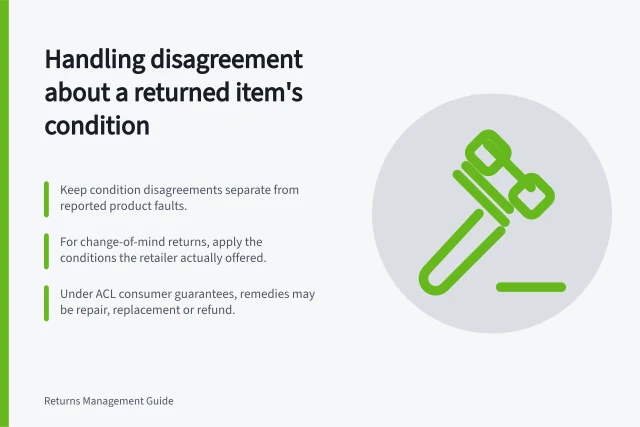
Explain a returned-item condition disagreement fairly: name the disputed question, separate observations from cause and offer a review path.
Returns Data
Check what a returned product should contain, count what arrived and resolve missing-part questions without assuming cause or blocking consumer-guarantee claims.
Returns Data
Turn specific sizing complaints into checked garment measurements and clearer size choices, then review later feedback without overstating the result.
Refund Operations
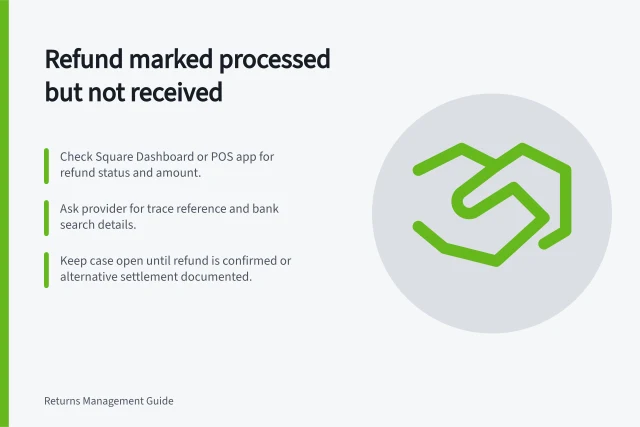
“Processed” can describe the merchant or provider step, while the customer's bank has not yet posted the credit.
Returns Data
Trace repeat return complaints to the product information available at purchase and assess whether an edit helped.
Returns Policy
Place return eligibility details where Australian shoppers need them and keep change-of-mind terms distinct from product-problem rights.
Refund Operations
A partial refund can resolve one missing item or a price adjustment while the rest of an order remains valid.
Returns Data
Map each return hand-off, owner and completion event so an online retail case can be followed from request to final outcome.
Refund Operations
The safest starting point for a refund is the original transaction.
Returns Data
Compare kept-sale contribution with actual return outcomes, account for recoverable stock and avoid counting a refund or later resale twice.
Refund Operations
Refund reconciliation is a bridge between three views: the store order, the payment-provider movement and the accounting entry.
Returns Data
Record a return’s arrival condition, images, tests and later changes consistently, while keeping observations separate from cause and remedy decisions.
Returns Policy
Choose a supported product, information or packing change to prevent recurring returns, then review later complaints without restricting customer remedies.
Refund Operations
Find where returned items wait, separate exception queues and set an inspection target based on your operation.
Refund Operations
A refund request is not complete when someone presses “refund”.
Exchange Workflows
An exchange request is not a stock reservation.
Reverse Logistics
Choose a return route, prepare accurate labels and follow parcel handover while accounting for Australian return-cost responsibilities.
Returns Data
A practical inspection workflow for Australian retailers: match returned items, record findings, hold uncertain stock and pass evidence to the remedy decision.
Returns Data
Measure return handling costs, recovered stock value and product contribution without double counting refunds or weakening customer commitments.
Returns Policy
Communicate clearly with Australian customers from a return request through assessment, delays, remedy and follow-up.
Returns Data
Build reliable item-level returns data, investigate patterns and check whether a product change improved outcomes.
Returns Data
Set proportionate checks for return misuse while preserving consumer-guarantee claims and a clear route for disputed cases.
Exchange Workflows
A practical guide to handling online returns in Australia, from the first request and remedy decision to item receipt, resolution and review.
Returns Portals
Plan a returns portal that captures useful requests, explains the next step and routes Australian consumer-guarantee claims for assessment.
Returns Data
Use real return cases, one targeted process change and comparable customer outcomes to improve a returns programme.
Reverse Logistics
A warehouse workflow for receiving, holding, routing and reconciling returned stock in Australia.
Returns Policy
Audit an Australian returns policy against ACCC guidance on change of mind, product problems, remedies, proof and return costs.
Returns Data
Check unusual return histories against orders and case records before escalating, while keeping genuine product-problem claims open.
Returns Policy
Compare cases exposed to a revised returns policy, check its intended outcome and look for confusion or blocked product-problem claims.
Reverse Logistics
A destination map for returned items, from inspection queues to approved stock and controlled holds.
Returns Data
Classify return spending by obligation, promise and preventable process work, then test a realistic saving without weakening customer outcomes.
Reverse Logistics
How to hold returned items, make a unit-level saleability decision and prevent damaged stock entering the pick area.
Refund Operations
Define the customer-wait clock, separate return routes and set a service target that exposes delayed and unresolved cases.
Exchange Workflows
Sending a replacement before receiving the original can reduce downtime for a customer, but it changes the business's risk.
Returns Data
Define the endpoints, product state, unit and variant behind a misunderstood dimension so buyers can judge physical fit before ordering.
Returns Portals
A mobile test procedure for return requests, covering order lookup, reason capture, submission, staff records and selected accessibility checks.
Returns Data
Interpret return tracking events, investigate gaps and use parcel evidence appropriately when deciding the next step in a return case.
Returns Data
Assess a product fix using affected orders, comparable return periods and the complaint the change was meant to address.
Returns Data
Connect the sale, return, parcel declaration and border records for returned goods, then check any concession against the actual item history.
Returns Data
Track non-resale returns from hold through approved disposition, physical movement and stock reconciliation.
Returns Data
An exchange completed is not proof that it retained a customer.
Returns Policy
Write returns instructions customers can follow, with separate routes for change of mind and product problems under Australian consumer guidance.
Returns Policy
Write return updates that tell customers the last confirmed event, the current action and when they will hear from the retailer again.