Returns Policy
Part of Returns management for online retailers
Distinguishing returns, exchanges and warranty enquiries
Triage return, exchange and warranty enquiries without letting a request label override Australian consumer-guarantee rights.
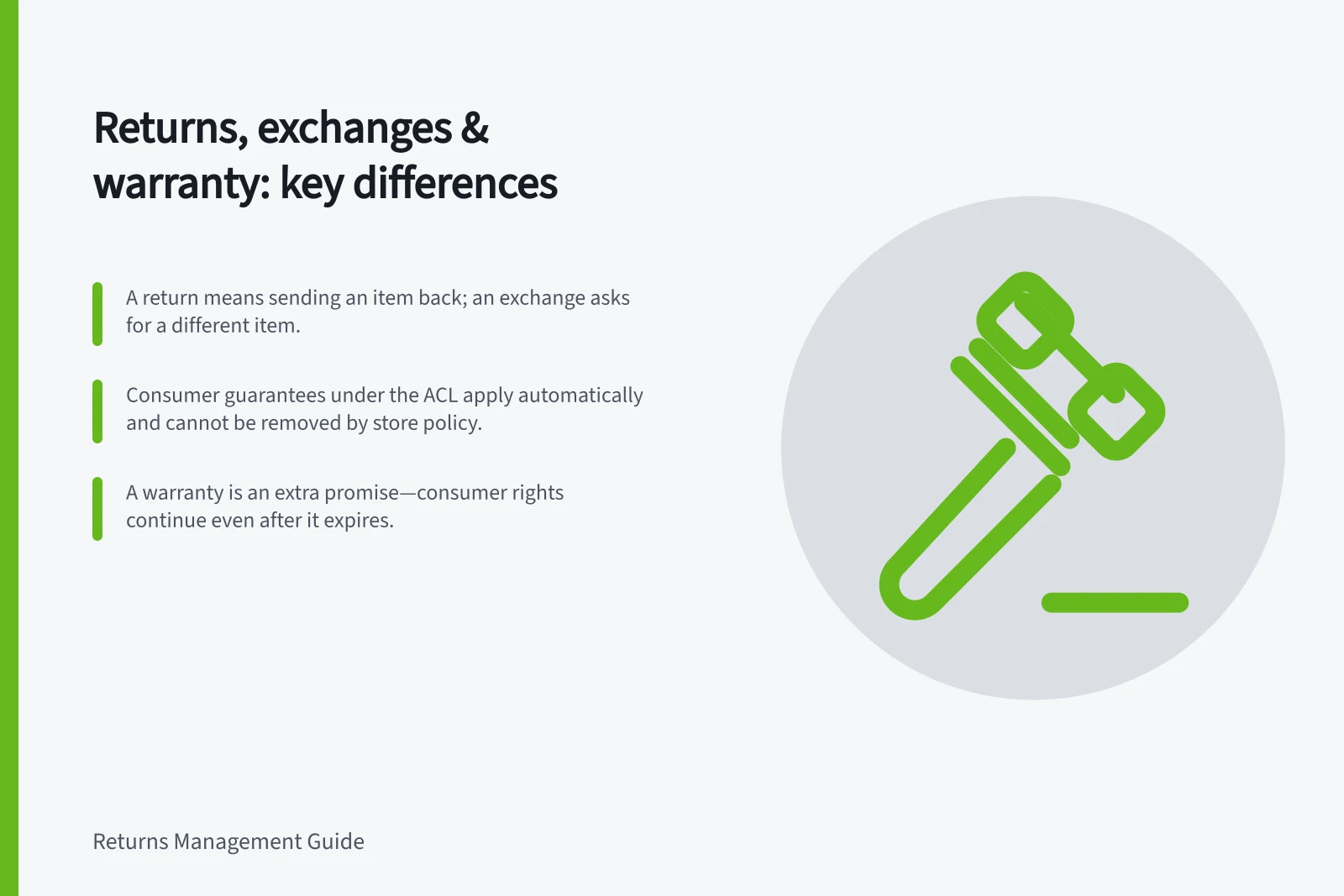
At intake, separate what the customer wants from why they want it. A return means sending an item back; an exchange asks for a different item; a warranty enquiry concerns a promise made by a seller or manufacturer. A return or exchange request can still involve a product problem, so the label alone does not determine the customer’s rights.
Ask about the issue and the requested outcome
Ask what is wrong or unsuitable and what outcome the customer wants. Record whether they want to send the item back, receive a different item or ask about a warranty, alongside the reported issue and whether it appears to be a change of mind, a product problem or both.
Check the order and what was supplied. Record the relevant receipt, docket, invoice or contract, the product details, the customer’s requested outcome and any warranty term they mention. The customer does not need to diagnose a manufacturing defect or name the law to raise a problem.
| Customer account | Working route | Check before deciding |
|---|---|---|
| “I chose the wrong size” | Possible change of mind | The offered store policy and whether another issue is reported |
| “You sent the wrong size” | Possible order or description mismatch | The ordered variant, supplied item and customer’s account |
| “It stopped working” | Possible consumer-guarantee or warranty claim | The reported failure, product details and any relevant promise |
| “I want another colour” | Exchange request | Why the change is sought, the basis for it and available stock |
These examples are starting points. A customer may request an exchange for a faulty item, or send an item back while seeking a repair. Do not confuse an exchange under store policy with a product problem that needs separate assessment.
Distinguishing Returns, Exchanges and Warranty Enquiries
- ReturnSending an item back, typically due to a change of mind or product issue. No requirement for original packaging under Australian Consumer Law (ACL).
- ExchangeRequesting a different item, which may be due to size, colour, or a faulty product. Must assess whether it's a change of mind or a product problem.
- Warranty EnquirySeeking support for a promise made by the seller, manufacturer, or extended warranty provider. Additional to ACL rights; does not override consumer guarantees.
Separate store policy from consumer guarantees
If the customer has changed their mind and there is no product problem, check the store’s change-of-mind policy and its conditions. That policy does not decide whether a product-problem claim is covered by consumer guarantees under the Australian Consumer Law (ACL). Those guarantees apply automatically and cannot be taken away by sales terms or policy conditions; original packaging is not required.
Do not classify a product problem as major, minor or merely a preference without assessing the reported facts. The ACCC gives a car radio that does not work as an example of a minor problem, and brakes that do not work due to a manufacturing fault as an example of a major one. A minor problem may be fixed within a reasonable time; for a major problem, the customer can reject the product and choose a refund or replacement, or keep it and seek compensation for any drop in value.
Key Consumer Guarantee Principles (ACL)
- Automatic ProtectionConsumer guarantees apply even without a written warranty.
- No Packaging RequiredOriginal packaging not needed to claim under ACL.
- Major vs Minor ProblemsMinor: fixable in reasonable time. Major: can reject and choose refund, replacement, or compensation.
Treat a warranty as an additional route
A voluntary, manufacturer’s or extended warranty is a promise additional to consumer guarantees. The guarantees exist regardless of a warranty and may still apply after it expires, so do not treat the warranty term as the expiry of the customer’s consumer-guarantee rights.
Record whether the customer is asking the seller or retailer about a consumer-guarantee problem, or asking about a manufacturer’s warranty. Consumers should first speak to the retailer or supplier who sold the product about a problem. Manufacturers also have consumer-guarantee responsibilities for acceptable quality, matching the product description, and repairs and spare parts being available for a reasonable time; a manufacturer that sells directly has the same responsibilities as a seller.
If a manufacturer is helping with assessment or repair, record who is arranging it and when the customer will receive an update.
Give the case a next action
Finish triage with a working category, an owner and a concrete next step: obtain an order detail, check a change-of-mind policy, assess a product problem or check the relevant warranty. Keep the customer’s requested outcome visible, and update the category and explain the decision if assessment changes the facts.
For consumer information, point customers to the ACCC or their relevant state or territory consumer agency, such as NSW Fair Trading, Consumer Protection WA or Consumer Vic. The ACCC accepts reports and can investigate misleading conduct, but it does not resolve individual disputes or give legal advice.