Returns Policy
Part of Returns fraud and misuse controls
Comparing fraud controls with legitimate customer inconvenience
Weigh each return check against the decision it clarifies, the genuine claims it delays and the evidence it actually adds.
Compare a returns control by the decision it may improve and the work it adds for genuine customers. A check that clarifies a few cases can still be a poor choice if it delays every valid product-problem claim. Compare its effects within the same return route.
Compare the proposed checks
| Control | Decision it may clarify | Burden to examine | Practical boundary |
|---|---|---|---|
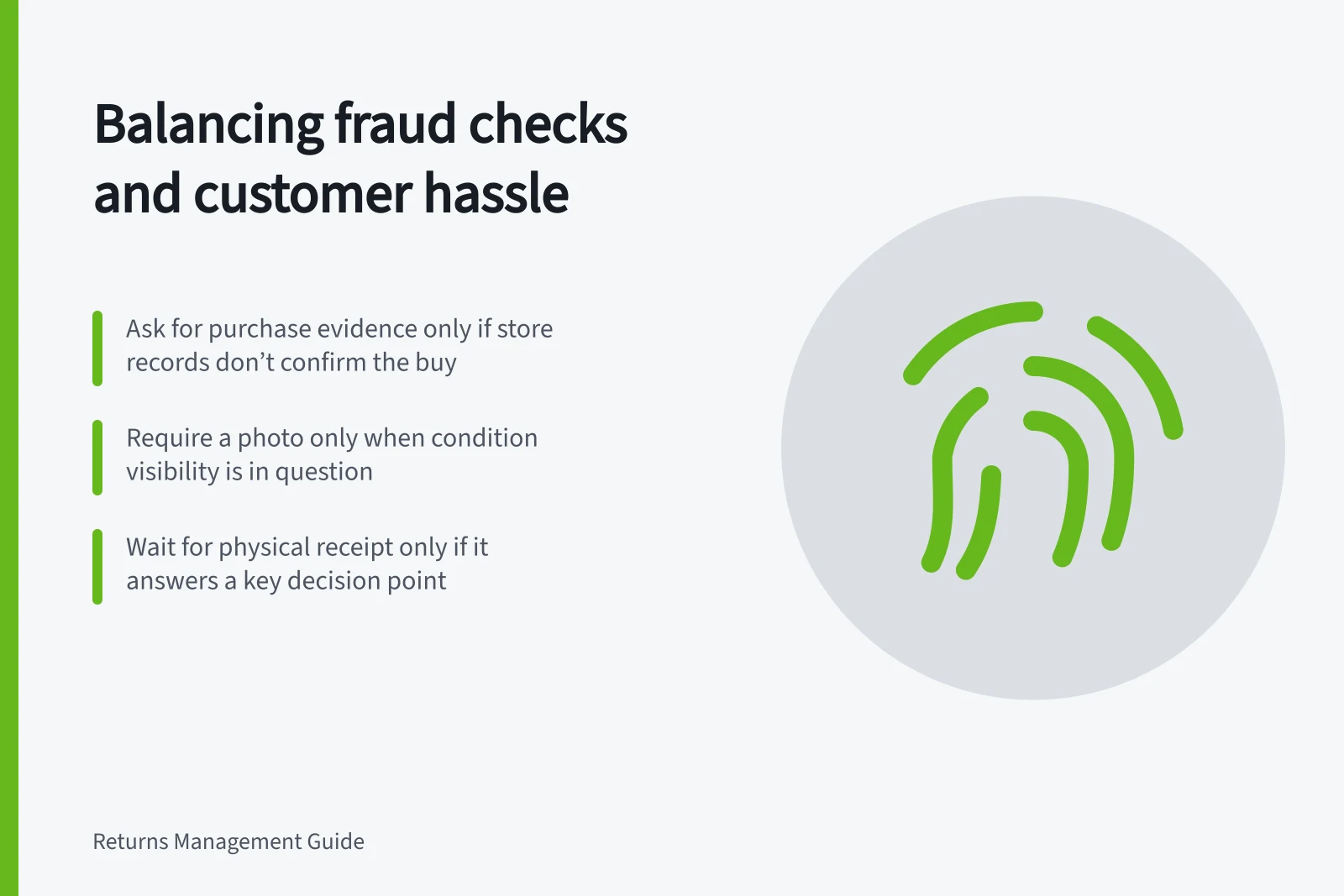
| Ask for purchase evidence | Whether the item was bought from the store | The customer may have to find a record the store already holds | Search the order first and accept reasonable alternative proof |
| Request a photograph | Whether visible condition needs review | Upload failure or a problem that cannot be photographed may block the request | Allow the case to start without an image when possible |
| Wait for physical receipt before deciding | Whether the expected item arrived | Cases supported by other evidence may wait unnecessarily | Require receipt where it answers a material question |
| Send an unusual pattern to staff | Whether case records conflict | Extra waiting and repeated questions | Refer a specific discrepancy with an owner and update date |
A retailer should choose among these checks using its own cases. A check gains no demonstrated benefit merely by appearing in a process.
Separate the return routes
Assess change-of-mind requests under the terms of the offer. Assess product-problem claims separately rather than as ordinary change-of-mind returns.
Proof of purchase illustrates the difference between a useful check and unnecessary work. Before asking the customer for more information, a retailer can check whether its own records identify the purchase. If they do, another request may add little.
Measure burden alongside errors
Before introducing a check, define the cases it will affect and the decision it should improve. Review incorrect outcomes it helped avoid, genuine claims delayed, extra customer contacts, abandoned requests and time to decision.
Read the underlying cases. Fewer refunds could reflect fewer incorrect payments or a growing queue of unresolved claims.
Compare similar cases over comparable periods. Note changes in product mix, return forms or staff practice that could also explain a difference.
Set a review date and a condition for narrowing or removing the check if it adds delay without useful evidence.
Key Considerations Before Introducing Return Checks
- Incorrect outcomes avoided
- Review before implementation
- Genuine claims delayed
- Track per return route
- Extra customer contacts
- Monitor post-intervention
- Abandoned requests
- Compare pre- and post-change data
Choose the smallest useful check
Use records the retailer already holds before asking the customer for more. Refer a case when a material discrepancy remains, and let staff correct a false flag.
If personal information is needed, limit it to the question being answered. Where the Australian Privacy Principles apply, collection and security obligations include collecting only information reasonably necessary and taking reasonable steps to protect personal information.
Keep a control only when observed cases support the improvement it makes to a specific decision and the burden on legitimate customers is acceptable.