Returns Data
Part of Returns programme improvement
Auditing a return process with real customer cases
Select varied customer cases, reconstruct each return timeline and turn failed hand-offs into specific process fixes.
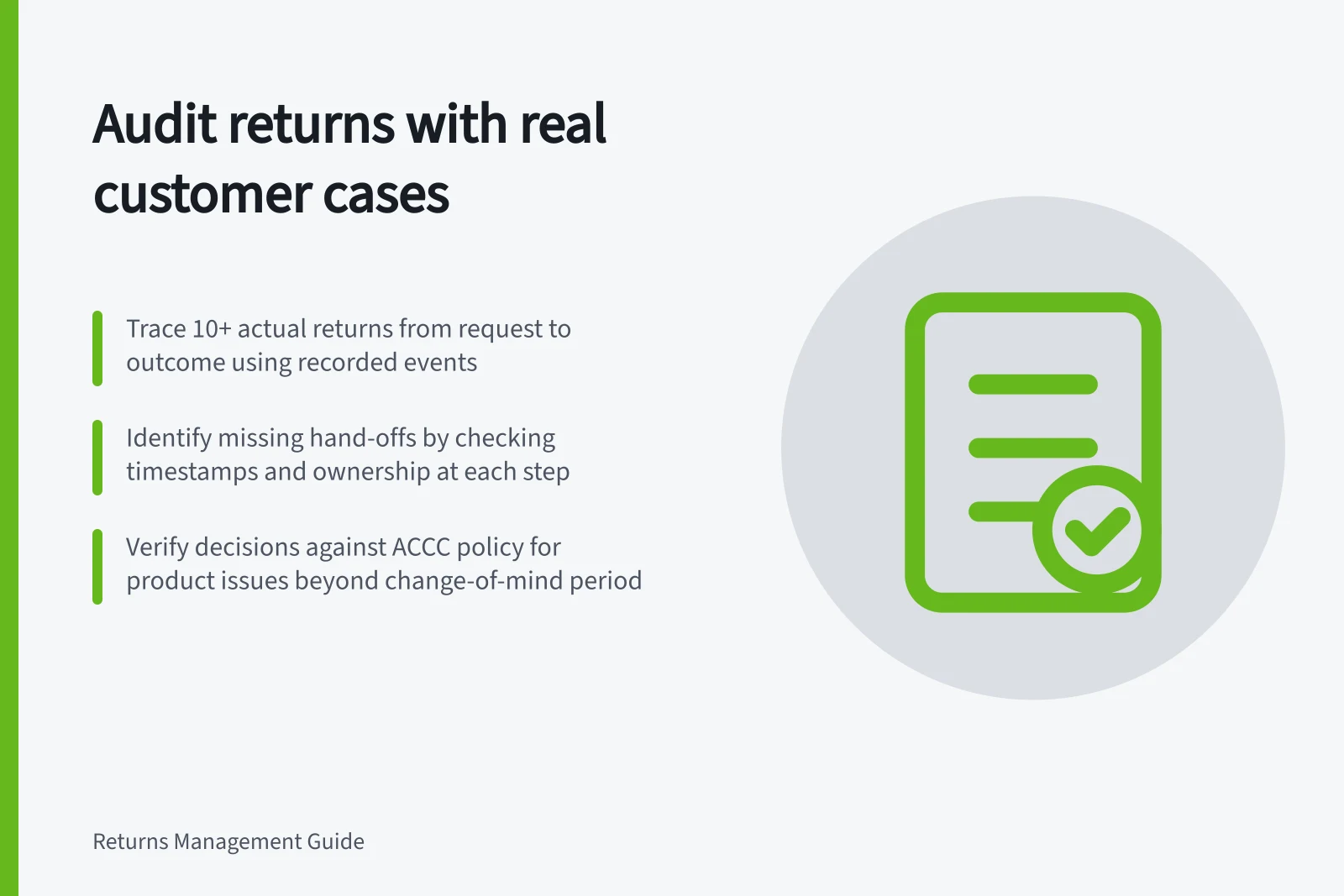
Audit an existing returns process by tracing real customer cases from the first request to the final outcome. Rebuild each case timeline from recorded events, compare hand-offs with the intended process and note what evidence is missing. Turn each fixable gap into an action with an owner, then check later cases to see whether the fix worked.
Select cases that reveal different failures
Choose cases from routes and products the retailer actually handles. Include straightforward completed cases alongside delayed, reopened, disputed and abandoned requests, plus a multi-item return and a reported product problem outside the voluntary change-of-mind period where those cases occur.
Record why each case was selected and how many cases you reviewed. Count findings within the sample, but do not treat the sample as a representative rate across all returns.
Use the case details needed to follow the process, such as the request, instructions and recorded outcome. Restrict access and remove customer identifiers from a wider findings report where possible; copying every message and attachment is usually unnecessary.
Reconstruct what happened
For each case, order the verifiable events: request, information received, instructions sent, carrier handover if relevant, warehouse receipt, assessment, decision, remedy action and customer update. Check the case record and relevant connected records, such as carrier tracking and warehouse receipt, and mark a missing timestamp as missing.
Distinguish what a record proves from what it does not. A carrier delivery scan does not prove receiving staff identified the item; a refund submission does not prove funds reached the customer.
At each hand-off, ask:
- Who owned the next action?
- What information did they have?
- What record shows the action was completed?
- What did the customer understand would happen next?
Follow each affected order line in a multi-item case. One item may be resolved while another remains under assessment. Keep the customer outcome separate from the physical destination of a returned unit.
Record a fixable gap
Describe each finding as observed event → failed or missing hand-off → effect → next check. For example, a carrier may mark a parcel delivered while no receiving match appears in the case; the next check is how unmatched parcels enter the exception queue. That sequence does not establish why the match was absent.
Prioritise gaps that delay or block a customer outcome. For a reported product problem, record the policy or process applied, the evidence supporting the decision and the reason given to the customer.
If a reported product problem was refused because the voluntary change-of-mind period had passed, check the decision against the retailer's stated policy and consumer-law information from the ACCC. Its “Repair, replace, refund, cancel” information concerns consumer-law rights and responsibilities; the ACCC says it does not resolve individual disputes or give legal advice.
For consumer help, the ACCC points people to local state and territory consumer protection agencies, also called consumer affairs or fair trading agencies. Record any unresolved question for follow-up rather than treating an audit finding as a legal decision.
Key Hand-Offs in the Return Process
- Who owns the next action?Identify responsibility at each hand-off point
- What information was available?Verify completeness of data shared between teams
- Was the action recorded?Check for evidence in system logs or case records
- What did the customer expect?Align communication with customer understanding
Hand over findings and check the fix
Group findings by failed step, count affected cases within the sample and assign an owner to each fix. State the sample's limit: it can expose a hand-off failure without establishing how often that failure occurs across all returns.
After a fix, review new cases on the same route. Check that the corrected step happened and that the customer outcome remained appropriate; if the gap recurs, record it for further action.