Returns Policy
Returns customer communication
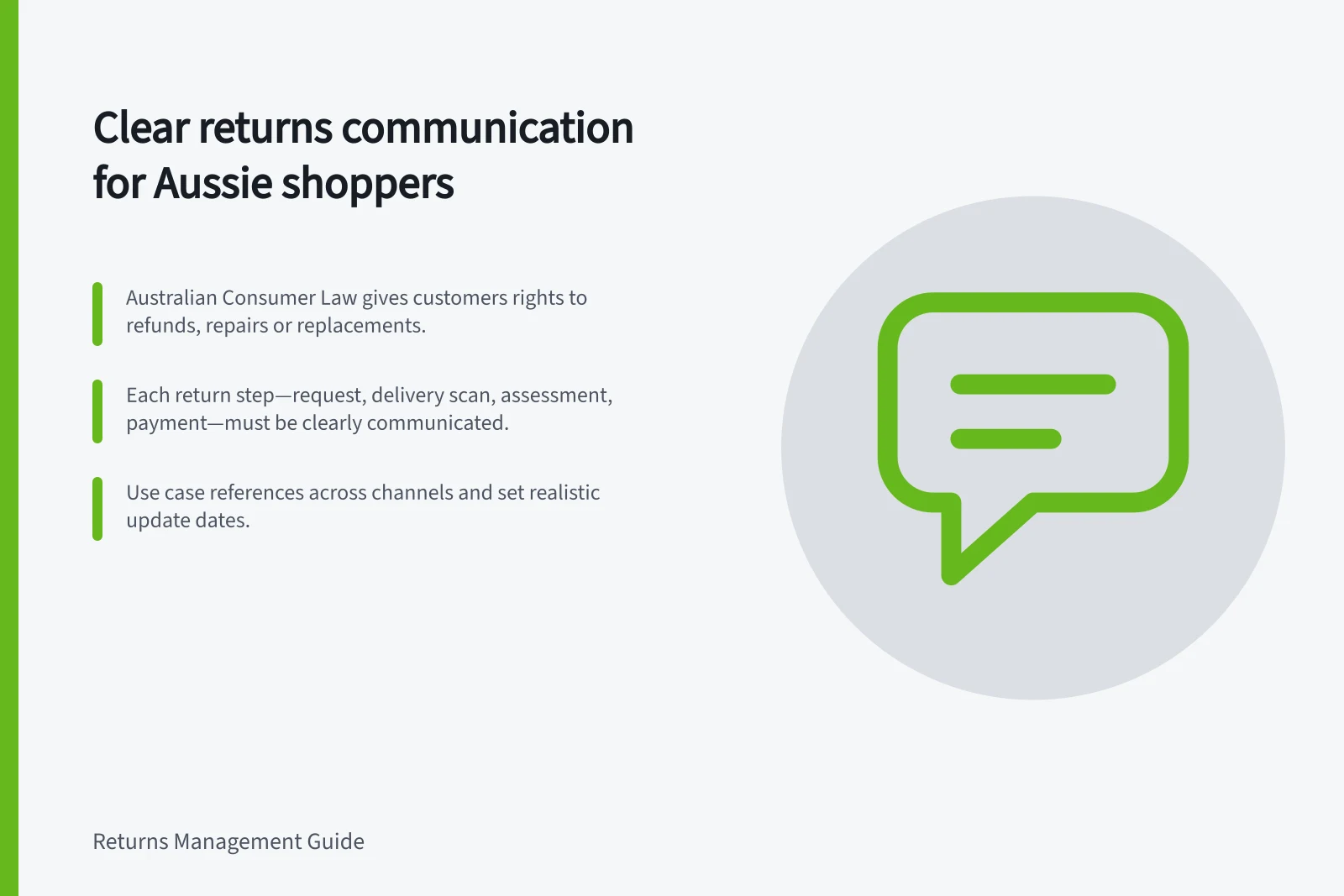
Communicate clearly with Australian customers from a return request through assessment, delays, remedy and follow-up.
Good returns communication tells the customer what the retailer knows, what remains undecided, what happens next and when they will hear back. Base each message on the case record. A parcel scan, a remedy decision and a completed payment are different events.
Start with the customer's account
Identify the affected item, describe the issue in the customer's own terms and confirm the outcome they asked for. Ask for more information only when it will help answer a specific question.
Keep a change-of-mind request distinct from a reported product problem. Explain any change-of-mind terms in the store policy, which cannot remove consumer-guarantee rights. The retailer may assess a reported problem before providing a remedy.
The Australian Consumer Law (ACL), part of the Competition and Consumer Act 2010 (CCA), includes consumer guarantees. Until the facts are clear, explain the assessment route without promising or denying a remedy.
Consumer Guarantees Under Australian Consumer Law (ACL)
- What is guaranteed?Goods must be of acceptable quality, fit for purpose, match description, and be safe.
- Remedy optionsRefund, replacement, or repair — depending on the fault and timing.
- Timeframe for remedyMust be reasonable — typically within a few days to weeks, depending on circumstances.
Acknowledge the concern before explaining the process
Listen for what the customer is objecting to, which may concern the price, the merchandise or the time taken. Thank them for raising it, show that you understand the concern and address each material issue.
Acknowledge the request promptly, then explain the next step and when the customer will hear from you. Offer a solution where one is available before explaining what the return process can and cannot do.
Tell the customer which event has happened
A return has several tracks: the request, the parcel or item, the remedy decision, and the payment or replacement. Name the confirmed event and the next step on the relevant track.
| Confirmed event | What to communicate |
|---|---|
| Request received | The item and issue recorded, and the next review or instruction |
| Return instructions sent | What the customer should do and how the item will be identified |
| Carrier marks parcel delivered | Delivery is recorded; item matching or inspection remains pending if that is the case |
| Assessment complete | The finding, decision and action that follows |
| Refund submitted or replacement dispatched | The action taken and any available reference or tracking detail |
A delivery scan does not establish which items arrived. Refund approval does not establish that money has reached the customer. Where items in one return have different outcomes, explain each separately.
Key Events in the Returns Communication Process
- Request receivedItem and issue recorded; next review or instruction provided
- Return instructions sentCustomer advised on actions and item identification method
- Parcel delivered (carrier scan)Delivery recorded; inspection or matching pending
- Assessment completeFinding, decision, and action confirmed
- Refund submitted or replacement dispatchedAction taken with reference or tracking details provided
Own the next update
Give a case waiting for a receiving check, specialist assessment, carrier enquiry or payment confirmation an owner and a review point. Tell the customer when the next update is due, using a date or interval the team can honour.
If the update is delayed, acknowledge the missed point, state the last confirmed event and explain the action under way. An update saying only “still processing” adds little.
Use a channel the customer can reply through. Keep one case reference across email, chat and phone notes so staff can see earlier statements and promises. Check the recipient before sharing order or payment details.
Monitor the channels customers use
A return concern may arrive by email, social media or an online review, not only through the channel where the order was placed. Monitor the communication channels your business uses so a complaint does not remain unanswered simply because it arrived somewhere unexpected.
Respond promptly and make clear how the customer can continue the conversation. Give a realistic date or interval for the next update, and change it if the team cannot meet it. Customer feedback can reveal a product or service issue, so pass relevant concerns to the team responsible for addressing them.
Using Customer Feedback Channels for Product Improvement
- ProsEarly detection of product issues; insight into customer experience across touchpoints; improves service design.
- ConsRisk of inconsistent responses if not monitored centrally; potential for reputational risk if ignored.
Explain a difference in accounts fairly
If an assessment differs from the customer's report, present the two accounts separately and distinguish confirmed findings from uncertainty. A mark on an item does not by itself establish when it occurred or whether it caused a reported fault. Invite the customer to clarify a material difference and have a person review it.
The selling business remains responsible for resolving a consumer-guarantee problem with a product it sold. A manufacturer's assessment can inform the decision, but the retailer should remain the customer's contact and give them a date or interval for an update.
Keep explanations accurate and understandable
Use plain, truthful explanations about the goods, the reported problem and the next action. Businesses selling goods and services in Australia must provide truthful information, and unclear wording can leave a customer unsure whether a statement is a confirmed fact or a provisional assessment.
Train staff who handle return conversations on the business's responsibilities under the ACL and the service approach they are expected to follow.
Finish with a clear outcome
The final message should identify the item, the decision and its basis, the action already taken, and anything still outstanding. A remedy for goods that do not meet a consumer guarantee may be a refund, replacement or repair, depending on the case.
If no remedy is offered, explain the assessment and give the customer a way to seek a review. For example: “Our assessment has not established that the goods fail a consumer guarantee. If you disagree, reply with information we may have missed or ask us to review the decision.”
If a refund has been submitted but its arrival is unconfirmed, say so and give the customer a way to follow up. Keep any promised action visible in the case until it is carried out.
Explain complaint escalation accurately
If a customer asks where to take an unresolved concern, distinguish information and reporting from individual dispute resolution. The ACCC accepts reports and uses them in its education, compliance and enforcement work, but it does not resolve individual complaints.
State and territory consumer protection agencies manage individual complaints and issues with businesses, and may offer voluntary dispute services. Direct the customer to the relevant agency for their state or territory without promising that it will decide the case or require a particular outcome.
Australian courts and tribunals, including state and territory tribunals, can enforce the ACL. Explain this as a formal dispute option, not as a guaranteed outcome.
In this guide
- Writing a useful return status updateWrite return updates that tell customers the last confirmed event, the current action and when they will hear from the retailer again.
- Explaining a delayed inspection or refundExplain which return step is delayed, what the retailer is doing and when the customer will receive another update.
- Handling disagreement about a returned item's conditionExplain a returned-item condition disagreement fairly: name the disputed question, separate observations from cause and offer a review path.
- Closing a return case with a clear resolution recordRecord the return decision, completed remedy and outstanding tasks before telling a customer what has been resolved.