Refund Operations
Part of Returns programme improvement
Setting a service target for return resolution time
Define the customer-wait clock, separate return routes and set a service target that exposes delayed and unresolved cases.
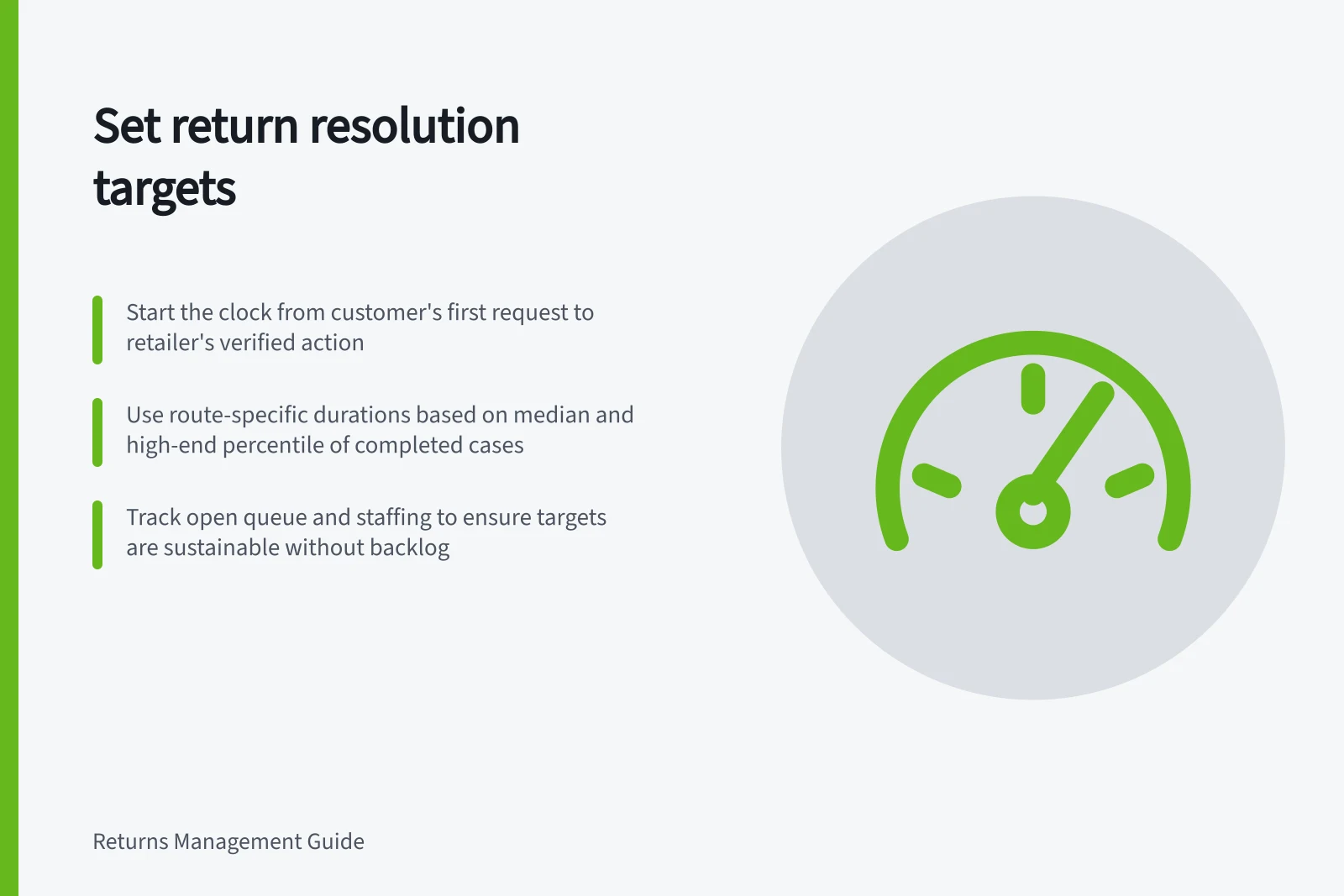
Define the customer-wait clock from the customer's first request to a verifiable, communicated retailer action. Segment cases by return route, then set a route-specific duration using completed-case times, the open queue and available staffing. Review whether cases meet the target without unresolved work accumulating or decisions being distorted.
Define the clock before choosing a target
Start at the customer's first request if the measure represents their wait. Time spent obtaining information, waiting for a carrier or seeking specialist assessment still matters to the customer. To see time under each team's control, record each hand-off and the team's next action as separate intervals while retaining the full customer-wait clock.
Define a stop event the retailer can verify and explain. For a refund route, that could be submission of the authorised refund and communication of that action, with payment arrival tracked separately. For a replacement, it could be dispatch and communication of the agreed item, with delivery still tracked.
For a declined request, use a reasoned decision communicated after the applicable review, and keep any dispute or promised action open. If later events remain outside the clock, call the measure time to the retailer's actioned outcome; do not describe it as the time until the customer received money or goods.
Separate routes and inspect the open queue
Review completed and still-open cases from the same period. Separate straightforward change-of-mind outcomes from product problems requiring assessment, bulky-item collection and repair routes. One average can hide a slow route or a long unresolved tail.
For each route, inspect the median and choose a consistent high-end percentile. Also count cases beyond each candidate target and note the oldest open cases. Use the median as a view of typical duration and the percentile and queue as evidence of the longer tail and current workload; none is a ready-made target.
Set a candidate duration from that route's completed-case times, then check how many cases would exceed it and whether available staffing can manage that workload alongside the open queue. Compare the candidate with the median and selected percentile, and choose a duration the operation can support. Reconsider the duration or the process and capacity if the queue shows that cases are already running beyond it.
Record the target in a consistent form: “For [route], the internal target is [duration] from [start event] to [stop event].” Fill in the duration using that route's case history and staffing plan, and use the same defined clock when reporting whether cases meet it.
Set a review date before using the target. At review, repeat the same measures for each route and compare similar periods.
Definition / Question to settle
- Start
- When was the customer's first request received?
- Stop
- Which recorded action and customer communication end the measured wait?
- Population
- Which routes and order lines are included?
- Waiting reasons
- What is awaiting the customer, carrier or specialist?
- Balance
- Are repeat contacts, reopened cases or incorrect outcomes increasing?
Use the target without distorting decisions
Assign an owner to cases nearing the target and a review point to cases that miss it. Give the customer an update based on the last confirmed event and the next action.
Keep any applicable consumer-law requirements separate from this operational measure. Consult current guidance or qualified advice for a specific claim.
After introducing the target, compare similar cases and inspect the open queue, repeat contacts and appropriateness of decisions. If closed cases become faster while unresolved work grows, change the process or capacity behind the target.