Returns Data
Part of Return shipping and labels
Tracking a return parcel before issuing a resolution
Interpret return tracking events, investigate gaps and use parcel evidence appropriately when deciding the next step in a return case.
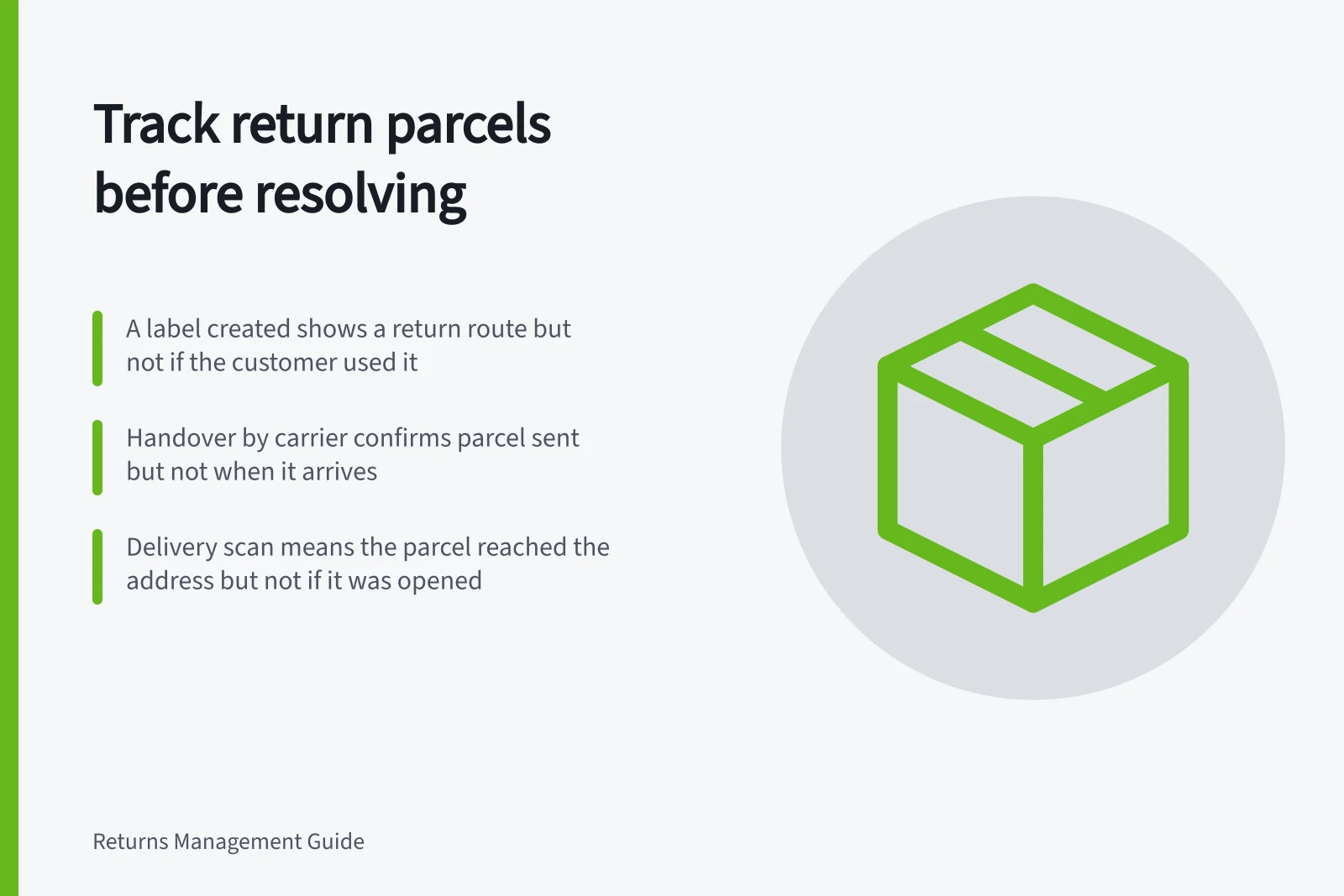
Use tracking to locate a return parcel and decide what to check next. A created label, carrier handover and delivery scan answer different questions.
None identifies the contents or determines the customer's remedy. A retailer may have enough evidence to resolve a case before the item arrives, so receipt should not be a universal precondition.
Read each event for what it supports
| Event | What it supports | What remains open |
|---|---|---|
| Label created | A return route and tracking reference were prepared | Whether the customer received or used the label |
| Lodged or collected | The carrier recorded handover | Whether and when the parcel will reach the return address |
| In transit | The carrier reports movement through its network | Final delivery and the parcel’s contents |
| Delivered | The carrier reports delivery | Whether the receiving team has found and opened the parcel |
| Contents matched | Staff identify the returned item and quantity | Condition, reported issue and appropriate outcome |
Treat each event according to what it records. Do not turn a label record into a claim that the store has the return.
Return Parcel Tracking Events and Their Significance
- Label created
- Return route and tracking reference prepared
- Lodged or collected
- Carrier recorded handover
- In transit
- Parcel moving through carrier network
- Delivered
- Carrier reports delivery to return address
- Contents matched
- Returned item and quantity verified by staff
Link the parcel to the case
Record the tracking number, carrier, expected return address, parcel count and affected order lines. Ask the customer to include a return reference. With customer-arranged shipping, obtain the tracking number and any lodgement evidence; the store may not receive those details automatically.
At the receiving point, record parcel arrival separately from the items inside. Match each returned item to its order line. Give an unexpected parcel an owner for identification. These are case-recording practices, not information supplied by carrier tracking.
Respond to gaps in the record
If there is a label but no handover event, ask whether the customer posted the parcel and whether they have lodgement evidence. If tracking stalls after handover, check the relevant carrier enquiry route and update the customer using the last confirmed event.
If a carrier marks the parcel delivered but the receiving team cannot find it, check the address, receiving area and available proof of delivery before asking the customer to send anything again.
Australia Post's Business Support Portal allows Business Credit Account users to enquire about a previously arranged parcel return and request proof of delivery. Other accounts and carriers have different support routes. Give a missing-parcel enquiry an owner and review date.
Decide the outcome on the available evidence
A business may assess a reported product problem before providing a remedy. A delivery scan can prompt an item check, but it does not automatically approve a refund. Equally, an absent scan does not automatically defeat a documented claim.
Consider the customer's account, handover evidence, any assessment genuinely needed and the applicable consumer-guarantee or change-of-mind route. Do not delay a decision solely to await a parcel if the evidence already supports the appropriate outcome.
Record the decision and its basis separately from the parcel timeline. Tell the customer what is confirmed and who owns the next action. Keep any later refund submission or replacement dispatch in its own payment or exchange record.