Returns Policy
Part of Writing a clear store returns process
Reviewing a returns policy with current consumer guidance
Audit an Australian returns policy against ACCC guidance on change of mind, product problems, remedies, proof and return costs.
Review an Australian returns policy in two passes. First, identify what the store voluntarily offers for change of mind. Then read every sentence as it applies to a customer reporting a product problem. Rewrite wording that suggests voluntary conditions limit consumer-guarantee rights.
Identify which promise each sentence makes
Mark each line as a change-of-mind term, a product-problem instruction or a possible-remedy explanation. If a line fits more than one group, clarify its scope.
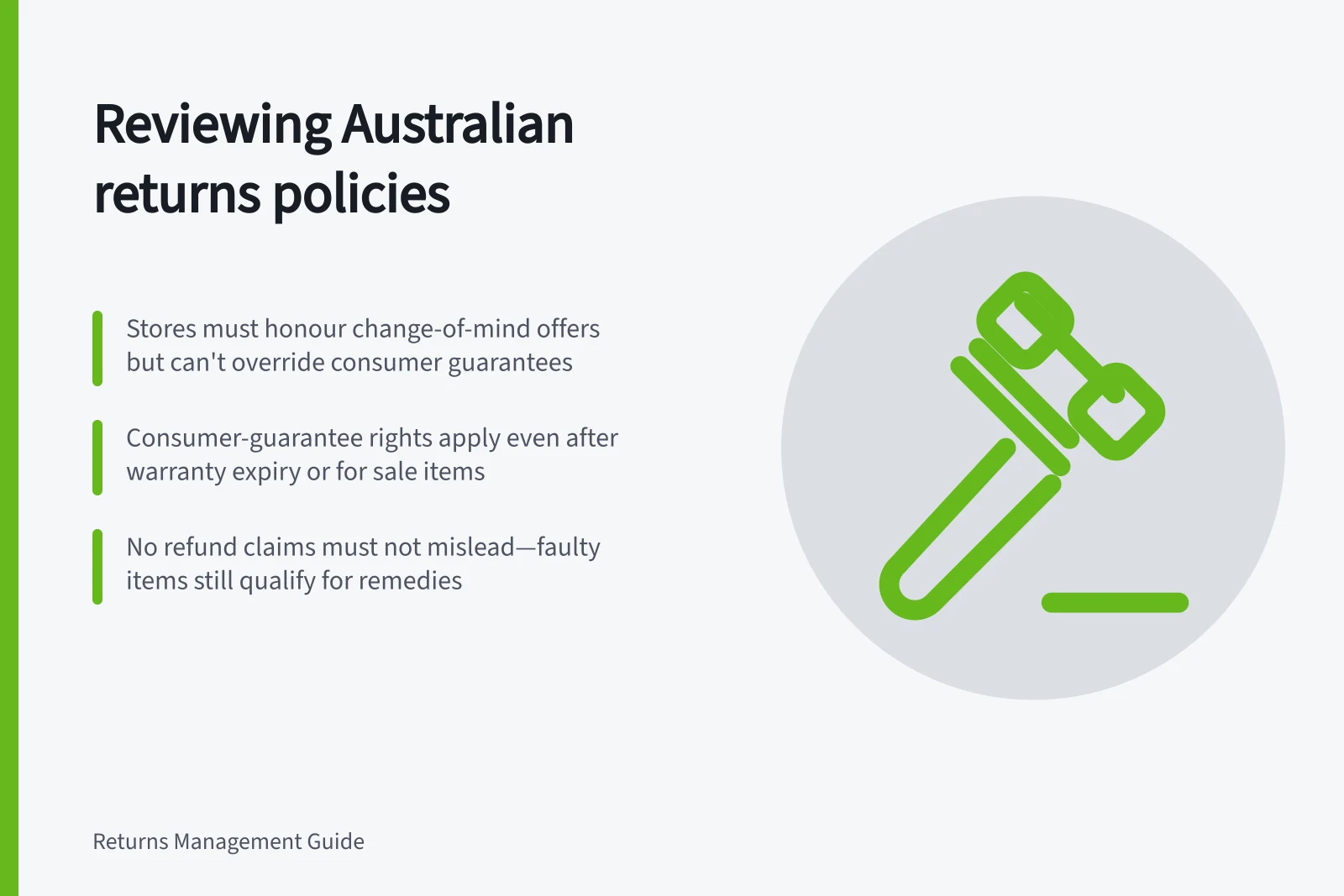
A store may set a period, product exclusions or packaging conditions for a change-of-mind offer. It must follow the offer it makes.
Those conditions cannot deny a remedy for a major or minor product problem under the Australian consumer guarantees. A warranty is an extra promise; its expiry does not by itself end consumer-guarantee rights.
Check prominent headings and short messages as well as the full policy. A qualification several paragraphs below “No refunds on sale items” may not undo the impression created by that line.
Consumer Rights vs. Voluntary Returns Policies: Key Differences
- ScopeMandatory under Australian Consumer Law (ACL)
- Applies toFaulty, unsafe or not as described products/services
- Time limitNo fixed time—rights apply for the life of the product’s reasonable expected lifespan
- Refund eligibilityYes, if repair/replacement isn’t possible or fair
- Proof of purchaseRequired by law; can include receipts, bank statements, emails or invoices
- Return costsBusiness bears cost for faulty items; may be passed on only in limited cases
- Voluntary change-of-mind policyOptional; must not override ACL rights
- ExclusionsCannot exclude consumer guarantees—even for sale or specialised items
Audit wording that could mislead
In a February 2025 sweep of Australian retail websites, the ACCC reported concerns about faulty-item time limits. It also flagged blanket exclusions for sale or specialised items, manufacturer warranties presented as the only remedy route, and restrictions or fees for faulty-item returns. These were concerns about potentially misleading wording, not findings about a policy supplied here.
| Wording to examine | Review question |
|---|---|
| “No refunds” or “sale items cannot be returned” | Is the statement clearly limited to a voluntary change-of-mind offer? |
| “Report faults within [store period]” | Does it wrongly make the store’s period a condition of a consumer-guarantee remedy? |
| “Unused and in original packaging” | Is this restricted to the change-of-mind offer? |
| “Contact the manufacturer after the warranty expires” | Does the store still explain its responsibility for consumer-guarantee claims? |
| “Customer pays all return postage” | Does the policy account for confirmed problems and large, heavy or hard-to-remove faulty items? |
| “Store credit only” | Could it rule out a refund or replacement the customer is entitled to choose? |
Check remedies and return instructions
Do not promise an immediate refund for every reported problem. A business may assess the product before providing a remedy.
Consumer guarantee rights are separate from any warranties offered by a business and cannot be taken away by anything a business says or does.
Review proof-of-purchase wording. The ACCC educates consumers and businesses about rights and responsibilities under consumer law and can investigate if a business breaks the rules about providing receipts or bills. It does not resolve individual disputes about receipts or bills not being provided.
Compare every policy location
Compare product-page messages, checkout text, FAQs, order emails, return forms and staff reply templates with the revised policy. A careful full policy can still be undermined by a contradictory short message. Record which guidance and date informed the review, and revisit the wording when the store’s terms or official guidance change.
Steps to Review an Australian Returns Policy Against ACCC Guidance
- Identify voluntary change-of-mind termsSeparate these from mandatory consumer-guarantee obligations
- Map each sentence to its promise typeChange-of-mind, product problem instruction, or remedy explanation
- Audit misleading wordingCheck for misrepresentations around time limits, exclusions and return costs
- Verify remedies and return instructionsEnsure compliance with ACL—no forced store credit or unjustified fees
- Compare all policy locationsAlign product pages, emails, FAQs and staff templates with the full policy
- Record guidance source and review dateRevisit policy when ACCC guidelines or business terms change