Returns Data
Part of Exchange workflows
Tracking whether an exchange prevented a lost customer
An exchange completed is not proof that it retained a customer.
An exchange marked complete does not by itself show that the customer stayed. Track whether the original issue was resolved and whether the customer bought again within a set follow-up window; treat a later purchase as evidence, not proof, that the exchange prevented customer loss.
Define completion properly
Record the exchange reason, requested variant, time to approval, return receipt, replacement dispatch and delivery. Confirm the customer received the correct item and did not open another case for the same problem; treat the case as complete only when these details are recorded.
Keep these fields in the exchange case record, linked to the customer and order by a consistent customer or order ID. Add fields for resolution confirmed, the confirmation date and whether the customer made another purchase.
Define a lost customer for this measure as one who makes no further purchase during the follow-up window you set. After delivery, check the linked customer's order history and record a subsequent purchase as yes, no or not yet due; mark no only after the window has elapsed.
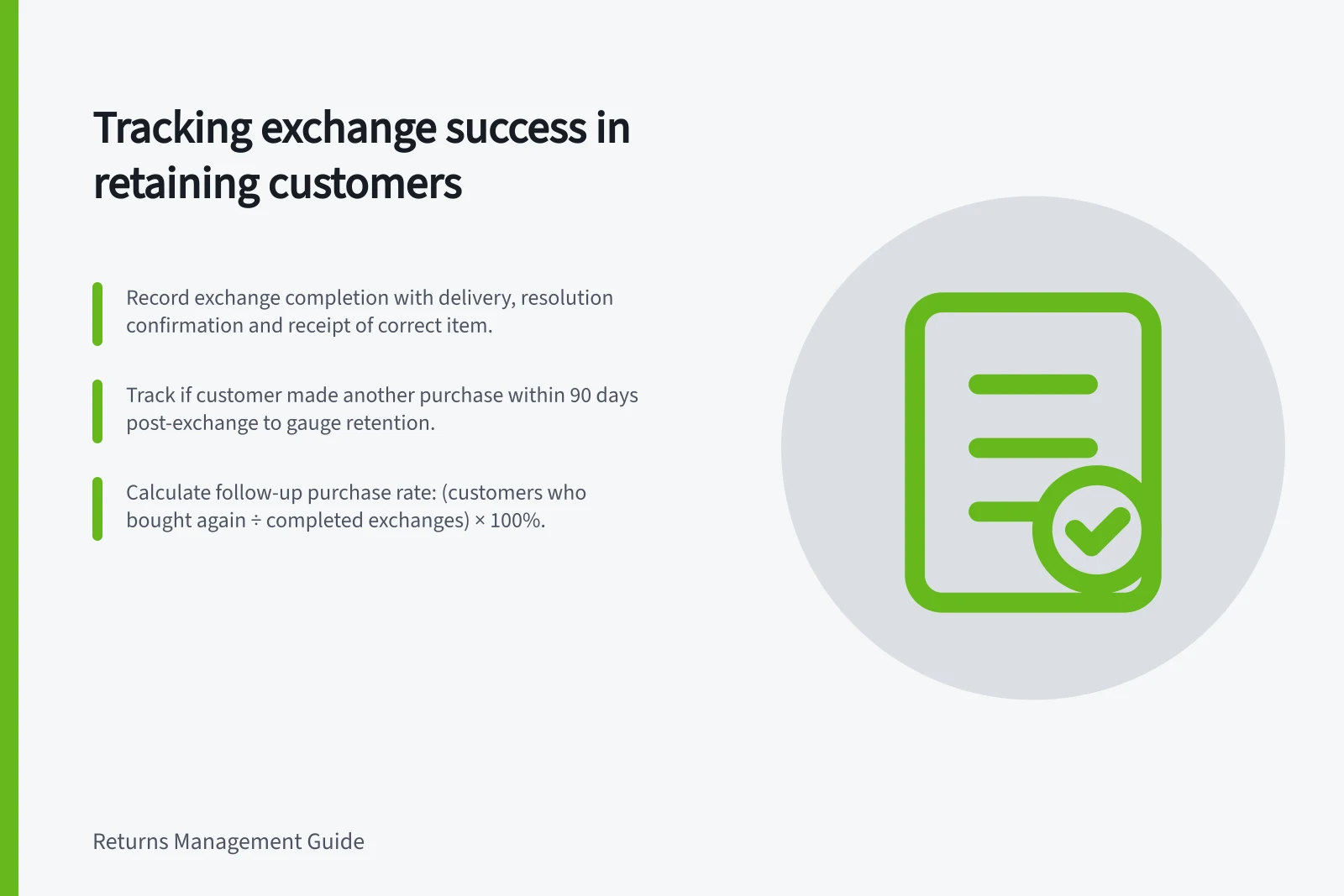
Calculate the exchange follow-up purchase rate as: customers with another purchase during the window ÷ customers with completed exchanges whose windows have elapsed. Report the numerator, denominator and percentage, leaving cases marked not yet due out until their window ends.
Keep these fields in a shared spreadsheet or customer management system if they are not available in your returns system. Examine repeat purchases and relevant satisfaction feedback over the same follow-up window.
Compare exchange customers with similar customers who had a refund or no issue, and calculate the same follow-up purchase rate for each group. Keep product fit and customer history in view, and compare like periods where seasonality may differ.
A higher rate after an exchange does not prove the exchange caused the later purchases. Product fit, seasonality and customer history may explain differences, so report the comparison without treating every later purchase as caused by the exchange.
Steps to Confirm an Exchange Prevented Customer Loss
- Record exchange reason, variant requested, approval time
- Track return receipt, replacement dispatch & delivery
- Confirm customer received correct item and no further case opened
- Check customer’s order history post-delivery within follow-up window
- Classify as retained only if a purchase occurred during the window
Look for a fixable pattern
Group exchanges by size confusion, damaged item, wrong product description or fulfilment error. A rise in exchanges may signal that the product page or packing process needs improvement; track extra shipping and handling costs alongside retained revenue.
Report exchanges completed, issues resolved, repeat contact and subsequent behaviour, including the comparison results. State the limits of the comparison rather than presenting later purchases as proof of retention caused by the exchange.
For a cause you have addressed, record the cause, the change made and its date. Then report the related exchange and repeat-purchase figures after the change.