Refund Operations
Part of Cross-border returns
Estimating whether a return-to-sender route is economical
Estimate an undeliverable parcel’s return route using available carrier options, additional costs and realistic recovery value.
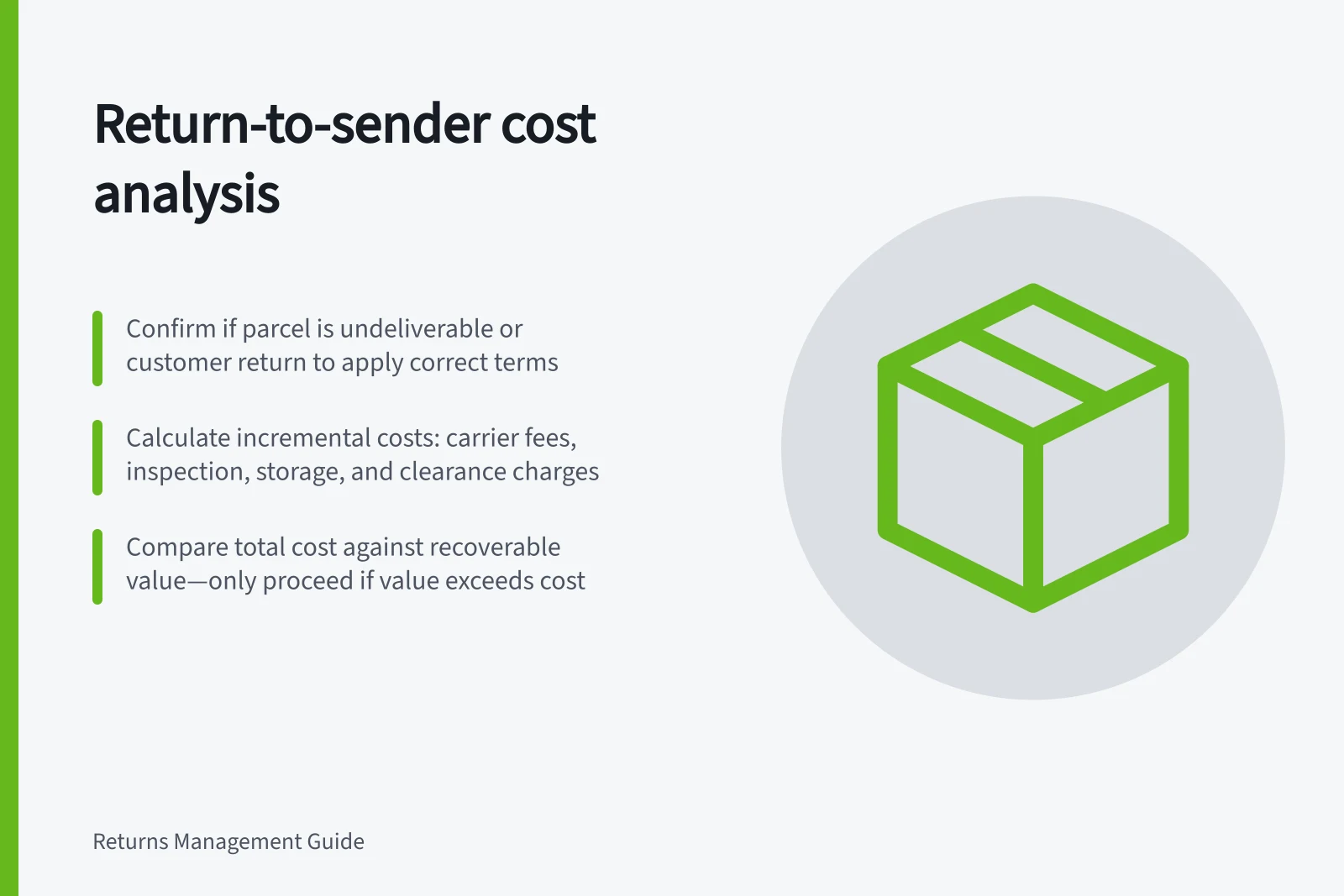
Estimate a return-to-sender route using the options still available for the parcel, the additional cost of each option and the value the business can realistically recover. First confirm the term: a carrier returning an undeliverable outbound parcel is different from a customer starting a return after delivery. Do not apply one service’s return terms to the other.
Find the decision still available
For an undeliverable parcel, record the last confirmed carrier event and the return address used. Ask the carrier whether return, redirection or another delivery attempt remains possible under that service. If the parcel is already travelling back, compare only decisions still open after receipt. A spreadsheet cannot change a completed carrier movement.
For a delivered item the customer wants to return, use the customer-return process. Where an Australian consumer reports a product problem, establish the remedy and transport responsibility on the case facts.
Key Considerations for Return-to-Sender Decisions
- Carrier event recorded
- Yes (confirm last confirmed movement)
- Return address verified
- Yes (ensure accuracy for return)
- Options available
- Check with carrier for return, redirection or retry
- Border charges apply?
- Only if goods return to Australia
Compare incremental cost and recovery
For each feasible option, estimate additional route cost as the sum of carrier or collection charges, border and clearance work, receiving and inspection, storage or onward movement, and any expected failed-delivery handling. Compare that total with the item value or fulfilled-sale value the option can realistically preserve. Mark uncertain charges and recovery estimates as provisional.
| Option to confirm | Often-missed cost | Possible value or outcome |
|---|---|---|
| Return the undeliverable parcel | Re-entry, receiving, inspection and possible re-dispatch | Recover stock or correct and fulfil the order |
| Redirect or attempt delivery again, if offered | Change fee and risk of another failed delivery | Complete the original delivery |
| Receive at a local facility | Receiving, storage and later forwarding | Identify or assess the item before a longer journey |
| No physical recovery, where permitted | Disposal or other required action | Close the item route without further freight |
Compare expected value preserved minus additional route cost for each feasible option. If costs exceed recoverable value, check whether another obligation or safety requirement still makes physical recovery necessary. Keep the customer outcome separate from the stock decision.
Original outbound spend is already incurred for this decision; show it in a wider order-profit review rather than adding it to every route option. Do not count a refunded sale twice as both reversed revenue and a transport expense.
Carrier charges and choices depend on the actual service. If goods return to Australia, check border charges and any claimed concession on the actual goods.
Record the choice and outcome
Keep the carrier service, available options, quoted charges, recovery assumption, customer commitment and route owner together. Recalculate if the parcel’s location or condition changes. After the route finishes, compare actual charges and item recovery with the estimate so later decisions use better inputs.