Returns Data
Returns data and root-cause analysis
Build reliable item-level returns data, investigate patterns and check whether a product change improved outcomes.
Returns data helps identify causes when each returned item links to its sale, the customer's account and staff findings. Record returns at item level, separate physical returns from requests and refunds, and compare patterns with units supplied to customers. A reason code suggests what to investigate; it does not establish cause.
Build an item-level record
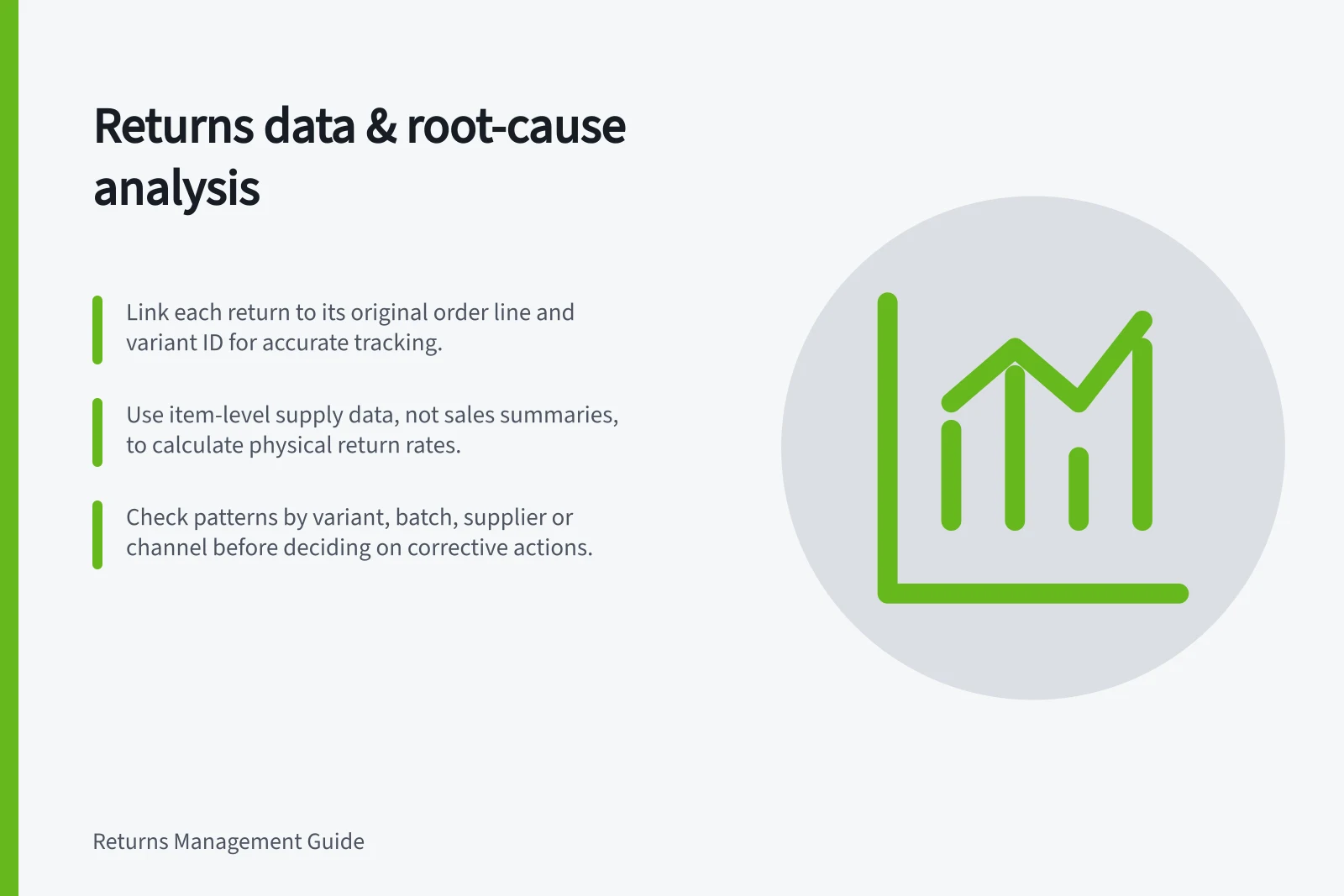
Link each returned item to its original order line and product variant. Record the quantity, order and receipt dates, the customer's reason and exact comment, any inspection finding, and the resolution. Keep separate records for different items in the same parcel.
Keep the stages distinct. A request may never lead to an item being received. A refund can be issued without a physical return, and an order can be cancelled before fulfilment.
For a receipt-based physical return rate, divide units received back by comparable units supplied to customers. Label request and refund measures separately. If a platform uses ordered units as its denominator, check whether cancelled or unfulfilled units are included before using its rate for this purpose.
Field / Question it answers
- Order line and stable variant ID
- Which supplied item does the return relate to?
- Order date and quantity supplied
- Which sales group forms the denominator?
- Request, receipt and resolution dates
- How far did the case progress?
- Customer reason and exact comment
- What did the customer report?
- Inspection observation
- What could staff verify?
- Suspected cause and confidence
- What still needs investigation?
Physical Return Rate vs. Request/Refund Rate: Key Differences
- Physical Return Rate
- Units received back ÷ Units supplied to customers
- Request/Refund Rate
- Requests or refunds issued ÷ Orders placed (may include cancelled/unfulfilled)
Use sales views to check the comparison group
Sales reports can locate comparable orders by time, product or sales channel. Shopify states its sales-report data is up to date, give or take about one minute, and can be refreshed to show newer data. Use item-level order records to confirm the comparison group reflects items actually supplied, rather than treating a sales summary as a return-rate denominator.
Check what a report counts before joining it to return cases. Shopify defines orders as orders placed on a given date; its gross-sales figures include pending, cancelled and unpaid orders. These measures answer different questions from units supplied. Retain the item-level supply definition when calculating a physical return rate.
Key Metrics for Returns Data Analysis
- Return Rate (Physical)
- Units received back ÷ Units supplied
- Sales Report Refresh Rate
- Up to 1 minute delay; manually refreshable
- ACCC Consumer Guarantees
- Mandatory under Australian Consumer Law (ACL)
Move from a reason to a testable cause
Group cases into themes such as fit, quality, expectation, transit damage and fulfilment error. Allow an unclear category. “Wrong size” could mean the buyer chose an unsuitable size, the size information was ambiguous, the wrong variant was supplied, or the item differed from its advertised measurements. Check the order, available listing history, item label and inspection notes before deciding what to change.
Look for patterns by variant, batch, supplier, sales channel or purchase period. Compare counts and rates: a popular item may have more returns in total, while a less popular variant has a higher observed rate. Read the underlying cases, particularly for small groups. A change in the reason menu or staff recording can also create an apparent trend.
State a possible cause as something that can be checked, then identify evidence that would support or weaken it. Handle each customer's reported fault through the appropriate remedy process.
Check how the recording process shapes the pattern
Before treating a change in recorded reasons as a product trend, map how a case moves from customer report through receipt, investigation and resolution.
Give the investigation a clear owner and share findings with whoever is responsible for the change. Record where evidence was added or a decision made, so later reviewers can distinguish a newly discovered cause from a change in case handling.
Match the action to the evidence
A listing that differs from the supplied item calls for an information or supply check. Damage found on arrival calls for a handling and packaging investigation. Repeated wrong-item reports call for a check of picking and order records.
Record what will change, which items or batches it affects, who owns the work and when customers could first receive the revised item or information.
Keep a dated record of relevant product information before editing it. This helps distinguish purchases made under the earlier page from purchases made after the edit, where that history is available.
Check comparable sales after a change
Compare orders affected by the change with a suitable earlier group. Give both groups a similar opportunity for items to be delivered and returned. Use the same definition of a return, and show units supplied and received back in each group. Check the targeted complaint and the overall physical return rate.
Treat the result as evidence, not automatic proof of cause. Promotions, customer mix, stock or supplier batches may have changed at the same time. A small group may justify continued monitoring. If the result remains unclear, record what further evidence is needed.
Use findings within their limits
A data pattern can guide investigation, but it does not decide an individual customer’s rights or remedy. The ACCC says it educates businesses and consumers about consumer guarantees and uses reports to inform its education, compliance and enforcement work; it does not resolve individual disputes or give legal advice about a particular situation.
Keep operational conclusions separate from customer-case decisions. If an investigation points to a recurring issue, document the evidence and the change made.
In this guide
- Distinguishing fit, quality and expectation-related returnsDistinguish fit, quality and expectation complaints while preserving the customer's account and assessing rights separately.
- Linking returns to product-page information gapsTrace repeat return complaints to the product information available at purchase and assess whether an edit helped.
- Comparing return rates across product variantsCompare physical return rates by variant with clear counts, a consistent denominator and enough time for returns to arrive.
- Tracking changes after a product issue is fixedAssess a product fix using affected orders, comparable return periods and the complaint the change was meant to address.