Reverse Logistics
Reverse logistics and warehouse handling
A warehouse workflow for receiving, holding, routing and reconciling returned stock in Australia.
The warehouse stage of a return runs from receipt to a recorded destination for each item. Match the arrival to a return case, hold it while its condition is unknown, decide its next action, then reconcile the physical item with its stock record. An uninspected return should not appear as available stock.
Define what enters the reverse flow
Reverse logistics covers the movement of products from end users back to a retailer or manufacturer, including returns, repair and recycling. The warehouse flow may also include unsuccessful business-to-consumer or business-to-business deliveries, surplus inventory, leased equipment and other hardware.
Identify which type of flow has arrived before assigning it a destination. A customer return, failed delivery and surplus item may all move backwards through the supply chain, but they do not necessarily share the same case or handling route.
Identify what arrived
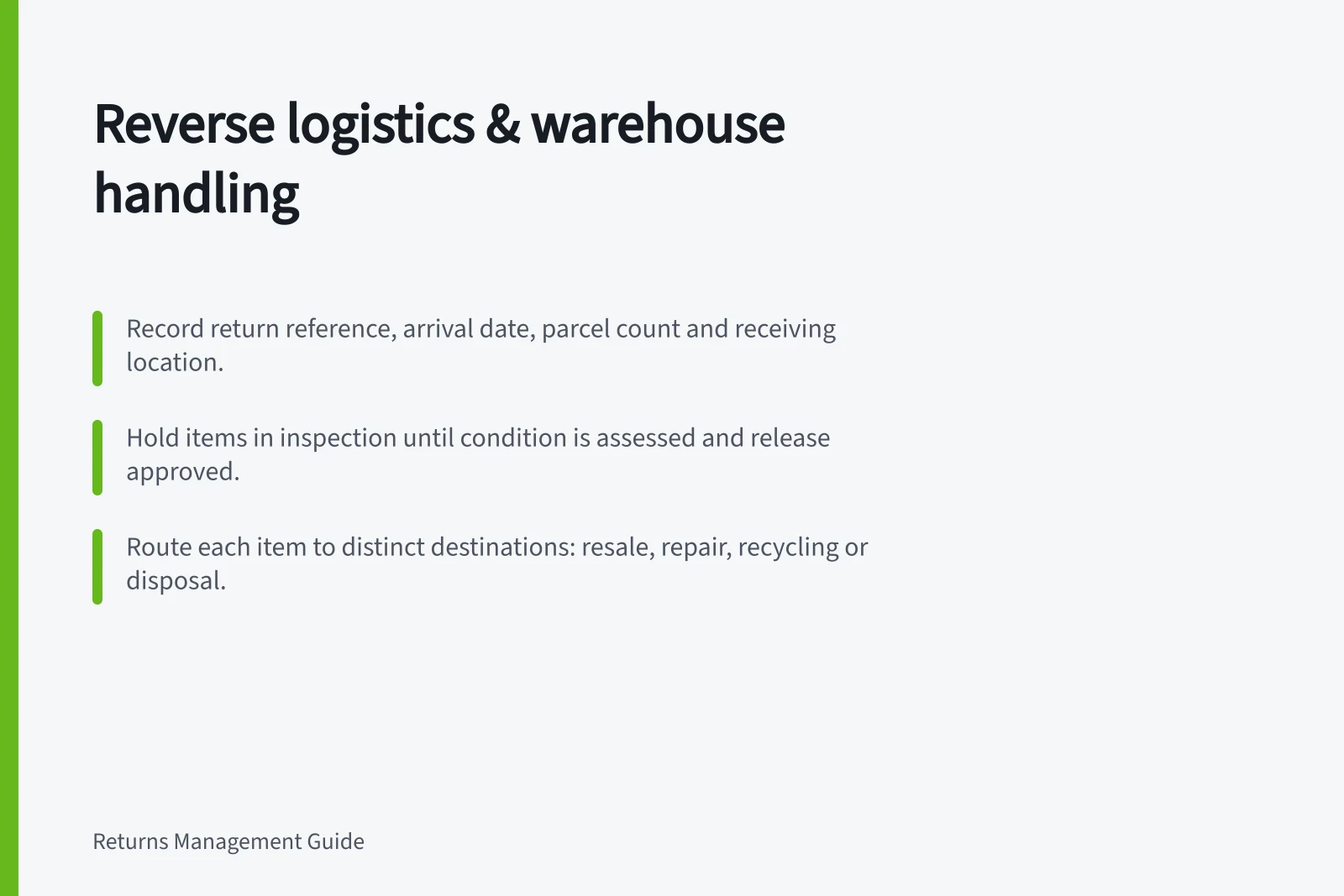
Record the return or order reference, arrival date, parcel count and receiving location. Check the contents against the expected items and quantities. Put an unmatched parcel in a labelled exception area and assign someone to resolve it. If one parcel contains items from several orders, match each item to its own case.
A carrier delivery scan confirms delivery to an address; it does not confirm which items the warehouse received. Keep parcel arrival and item receipt as separate events.
Hold items until a decision is made
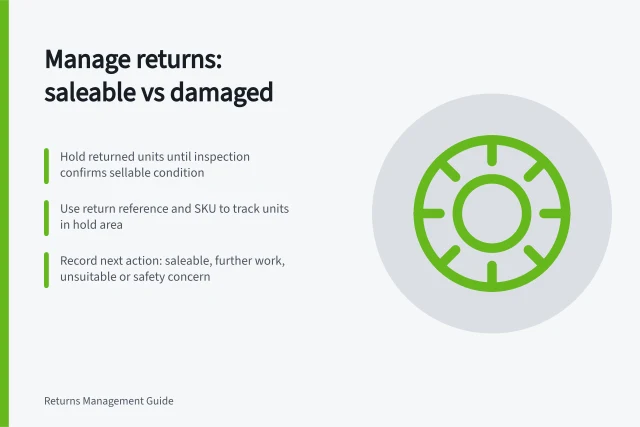
Place received items in an inspection hold. An intact carton does not establish that its contents are complete or suitable for sale. Record the condition decision and who approved release to saleable stock. Items needing another check, repair assessment or a safety review remain unavailable for picking.
Keep the customer's remedy decision separate from the warehouse grade, and treat a store's change-of-mind policy as a separate matter. Pass inspection findings to the person handling the customer's case.
Route the next action
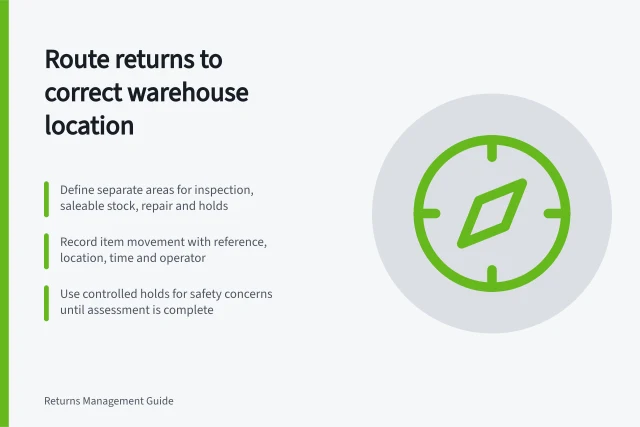
Give each destination a location code and purpose: inspection, exception handling, approved stock or a controlled hold. Record the item, quantity, current location, stock state, next action and owner at each hand-off. In a multi-site operation, confirm which site physically holds the item before updating that site's quantity.
Inventory systems vary. Some distinguish on-hand stock from stock available to sell, but a quantity state may not identify an individual returned unit or its shelf. Check how the order and warehouse systems share changes, and keep a separate unit record where needed.
Keep disposition lanes distinct
A returned item may be directed towards replacement, repair, refurbishment, resale, recycling, raw material reclamation or disposal. Treat these as distinct physical destinations rather than one general returns area, so the item's intended next action remains clear while it is being handled.
Use the destination to guide the hand-off and stock-state update. An item awaiting repair or refurbishment is not the same as one approved for resale, and an item directed to recycling or disposal should not be counted as saleable inventory. Make the receiving and onward destination visible to the people responsible for each warehouse hand-off.
Reconcile and clear holds
Compare items received with items inspected, released, moved elsewhere and still held. Investigate unmatched parcels and unexplained adjustments. Give each held item a reason, owner and review date. If a return suggests a safety problem, prevent its sale and escalate it through the product safety process.
Review where items wait: matching, inspection, a specialist decision or a final stock update. Address the queue causing the delay. For every hold, record its location and stock state, and update both when it moves or a decision clears it.
Manage stock linked to a safety recall
If a returned product suggests a possible safety issue, investigate whether it may or will cause harm to consumers. The risk assessment should consider the product, its defect or dangerous characteristic, and the hazard. Keep affected stock from being sold while the issue is escalated through the product safety process.
If a recall is needed, identify the affected products and assess the risk before preparing the recall. Where more than one supplier is affected, decide which supplier will lead it. The recall's objective is to remove the hazard from consumers and the marketplace as quickly as possible.
A supplier must tell the ACCC about a recall within 2 days of taking recall action. When submitting a recall notification, the supplier can also make a mandatory report about a death, serious injury or serious illness associated with a consumer good or product-related service it supplied.
Track and review recall progress, report on its success and adjust the approach if needed. There is no set timeline for completing a recall; the supplier needs to consider whether enough has been done to reduce the risk to consumers. Keep the warehouse stock state and location aligned with the recall action while it remains in progress.
Australian Regulatory Requirements for Product Recalls
- Mandatory Report Trigger
- Death, serious injury, or serious illness linked to a consumer good
- Recall Objective
- Remove hazard from consumers and the marketplace as quickly as possible
- No Set Timeline
- Supplier must assess whether enough has been done to reduce risk
In this guide
- Separating saleable returns from damaged stockHow to hold returned items, make a unit-level saleability decision and prevent damaged stock entering the pick area.
- Routing returns to the right warehouse locationA destination map for returned items, from inspection queues to approved stock and controlled holds.
- Reducing delays between receipt and inspectionFind where returned items wait, separate exception queues and set an inspection target based on your operation.
- Tracking return inventory that cannot be resoldTrack non-resale returns from hold through approved disposition, physical movement and stock reconciliation.