Returns Data
Part of Reverse logistics and warehouse handling
Tracking return inventory that cannot be resold
Track non-resale returns from hold through approved disposition, physical movement and stock reconciliation.
Record each non-resale return until its physical destination and stock adjustment agree. A non-saleable decision does not prove repair, transfer, recycling or disposal. The record must show which step has occurred.
Record the hold
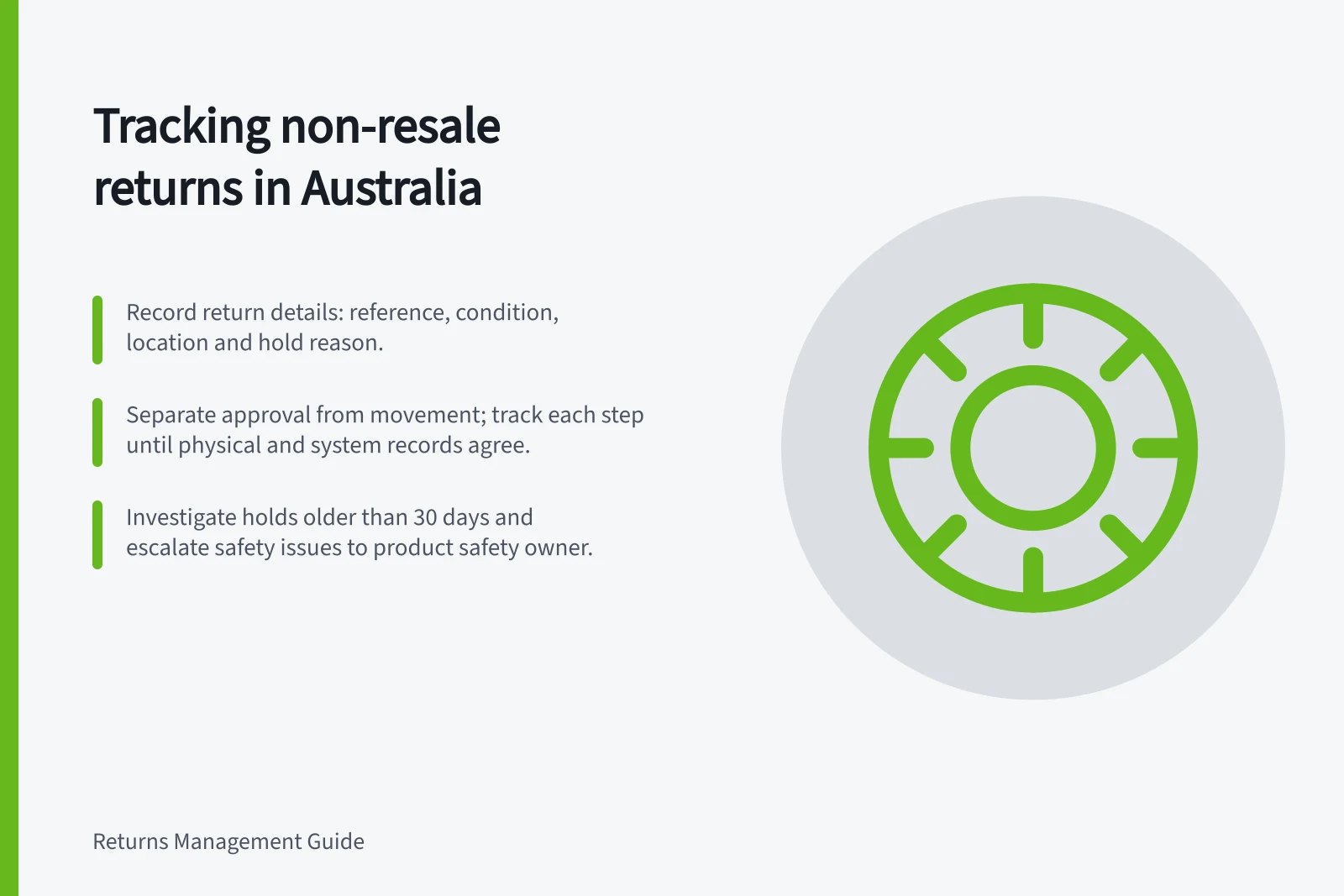
Record the return reference, item identifier, quantity, physical location, observed condition, hold reason and decision owner. Use reasons that lead to different actions: confirmed damage, missing parts, a safety concern or supplier assessment. Never label an uncertain condition as confirmed damage.
If the item is counted as on-hand inventory, keep its quantity unavailable for sale where the system supports that distinction. Shopify, for example, has unavailable quantities for damage and quality control.
These are quantities by variant and location; they do not replace a record identifying the particular returned unit. Confirm how any connected warehouse or accounting system handles the same stock before making an adjustment.
Separate approval from physical movement
Track received → held → route approved → moved or removed → records reconciled. At approval, record who authorised the next destination. The item might go to repair assessment, a supplier under an agreed process or another documented route. Placement in a disposal cage is a move to a hold location, not proof of disposal.
When an item leaves the location or your custody, record the date, quantity, destination and relevant transfer or collection reference. Make the corresponding stock adjustment according to the system's process.
Keep enough evidence to explain a later variance without putting unnecessary customer details in a warehouse record. Ask the finance owner to determine valuation or write-off treatment; a condition code does not do that.
Reconcile open items
Compare physical counts in each hold area against unavailable quantities and open unit records. Investigate movements without a record, adjustments made before a physical move, and duplicate records for one returned unit. Review old holds by age and owner so pending decisions stay visible.
If a return suggests a safety issue, prevent it from being offered for sale and escalate it to the product safety owner. Australian product safety guidance calls for suppliers to investigate suspected risks and act to protect the public.
Whether a wider recall is needed requires a separate assessment. Close the warehouse record when the item's physical destination and the relevant stock records agree.
Return Disposition Guidance (Australia)
- Product Safety Authority
- Products Safety Australia (www.productsafety.gov.au)
- Recall Threshold
- Requires separate assessment beyond individual return handling
- Public Protection Duty
- Suppliers must investigate safety concerns promptly