Returns Policy
Part of Returns management for online retailers
Defining a returns objective beyond reducing volume
Set a returns objective that measures correct customer outcomes and operational delays alongside return volume.
A useful returns objective names the customer and retailer outcome to improve, then defines how the team will check progress. “Fewer returns” is incomplete: a lower count could reflect fewer sales, delayed cases or customers who could not obtain an appropriate remedy. Start with a problem the team can investigate, such as slow decisions, repeat contacts or a recurring product mismatch.
Name the outcome
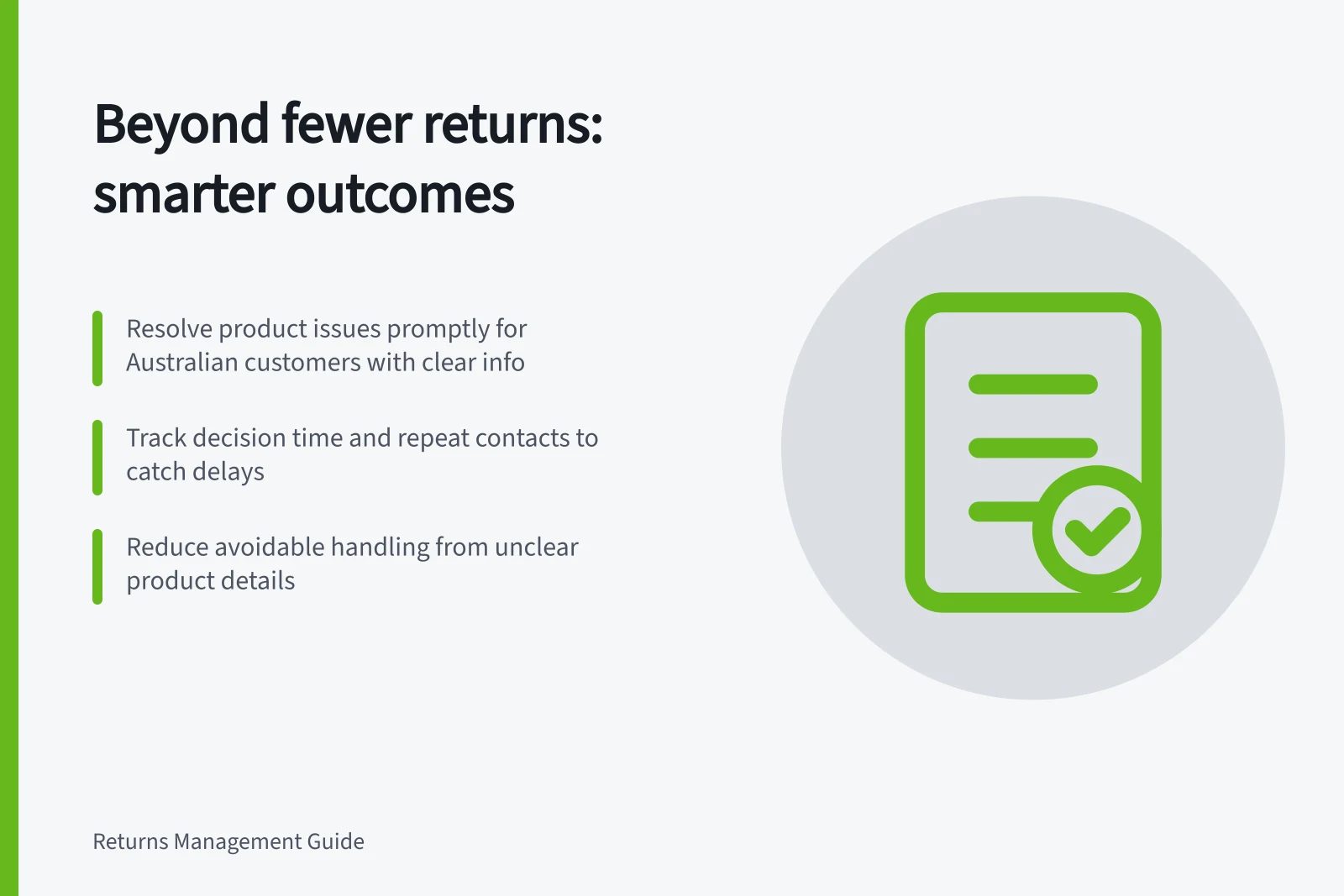
Write a sentence with an audience, outcome and boundary. For example: “Resolve reported product problems promptly and correctly for Australian customers while reducing avoidable handling caused by unclear product information.” This is an illustrative objective, not a measured result or a universal target.
The ACCC says it educates consumers about consumer guarantees and can investigate businesses that mislead people about their rights. It does not resolve individual disputes or give legal advice about a consumer’s right to a repair, replacement or refund.
Pair the outcome with balancing measures
Choose a primary measure that fits the problem and a second measure that might reveal an unwanted effect. The following are suggested internal definitions, not industry benchmarks. State each denominator and exclusion when reporting it.
| If the problem is… | Measure to define | Balancing check |
|---|---|---|
| Cases wait without a decision | Time from a request with the information needed for assessment to a recorded decision | Repeat contacts and cases still awaiting assessment |
| Returned items sit unaccounted for | Time from warehouse receipt to recorded item destination | Unmatched parcels and items released without approval |
| One product creates repeated mismatches | Relevant complaints per comparable units supplied | Physical returns and unresolved fault claims for that product |
| Customers cannot tell what happened | Cases with an outcome communicated | Follow-up contacts about the same case |
Use events the team can identify. A carrier delivery scan is not the same as matching an item to a case. If the dashboard calls both “received”, readers cannot tell which delay it measures.
Balancing Measures for Returns Objectives
- Problem: Cases wait without a decision
- Time from request (with complete info) to recorded decision
- Balancing check: Repeat contacts and unresolved cases
- Number of follow-up contacts and cases still awaiting assessment
- Problem: Returned items sit unaccounted for
- Time from warehouse receipt to recorded destination
- Balancing check: Unmatched parcels and unapproved releases
- Items released without approval or not matched to a case
- Problem: Recurring product mismatch
- Relevant complaints per comparable units supplied
- Balancing check: Physical returns and unresolved fault claims
- Number of physical returns and unresolved claims for the same product
- Problem: Customers cannot tell what happened
- Cases with outcome communicated to customer
- Balancing check: Follow-up contacts about same case
- Number of repeat inquiries on the same return case
Establish a baseline and review it
Define which cases belong in each measure before comparing periods. Keep requests separate from physically returned items, and distinguish refunds from exchanges. Compare similar order groups where possible: recent purchases have had less time to generate a return. Show counts beside rates, especially for small groups.
Set a review date and an owner who can act on the finding. If a measure worsens, inspect cases before changing a policy. If it improves, check the balancing measure and whether product mix, supply or recording changed. An observed difference does not by itself show that one process edit caused it.
The objective should help staff resolve legitimate problems, keep the item and payment trail clear, and investigate preventable friction. Report a reduction in return volume when comparable data supports it.
Establishing a Returns Objective: A Step-by-Step Approach
- Define the audience, outcome, and boundaryExample: Resolve reported product problems promptly and correctly for Australian customers while reducing avoidable handling caused by unclear product information.
- Pair the outcome with balancing measuresChoose a primary measure and a second measure to detect unintended consequences.
- Establish a baseline before comparisonDefine inclusion rules for cases, separate refunds from exchanges, and compare similar order groups.
- Set a review date and assign ownershipEnsure someone can act on findings. Investigate causes if metrics worsen.
- Report progress only when supported by comparable dataAvoid claiming reduced return volume without verified, consistent data.