Returns Policy
Part of Returns customer communication
Closing a return case with a clear resolution record
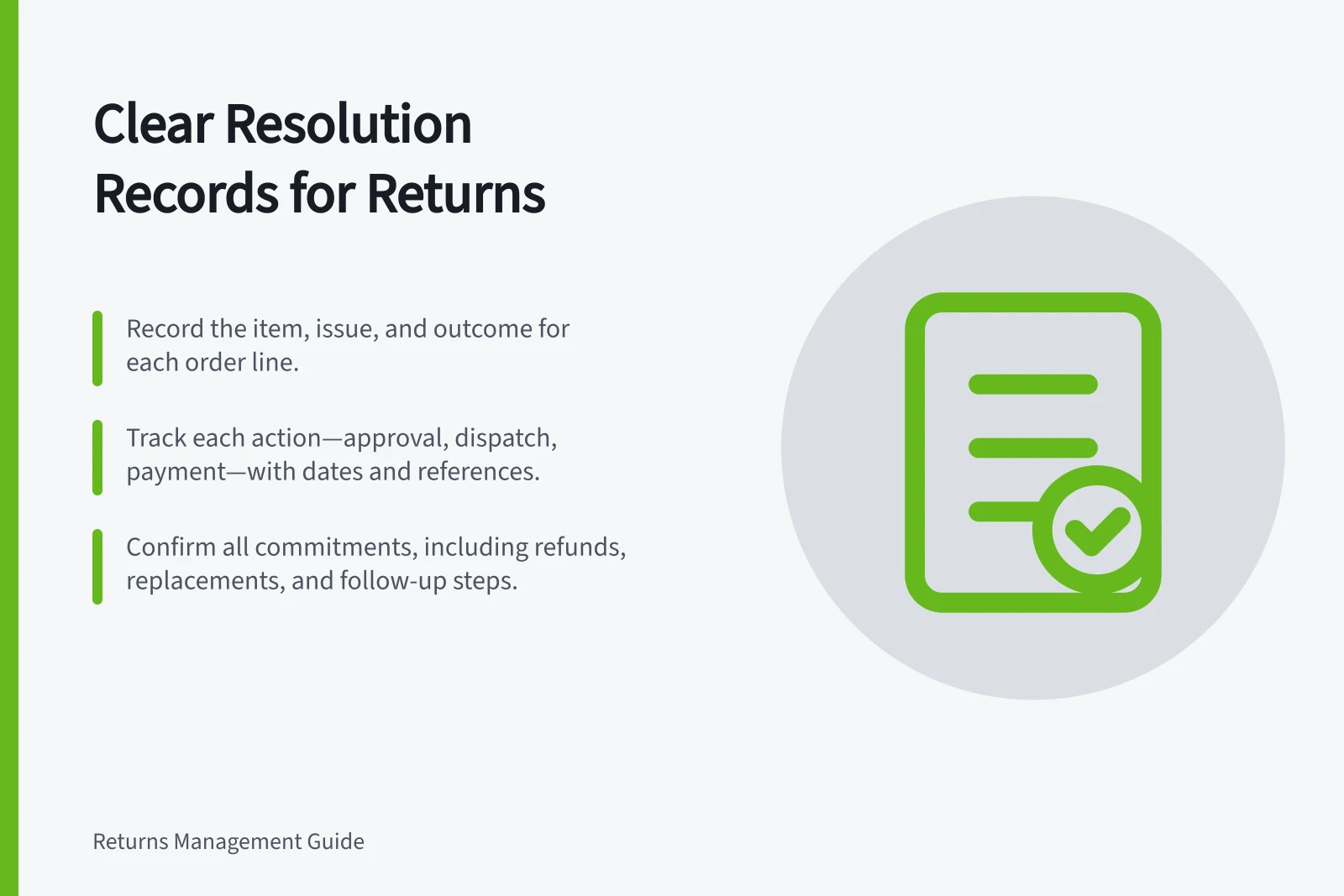
Record the return decision, completed remedy and outstanding tasks before telling a customer what has been resolved.
A clear resolution record answers the same questions for the customer and the next staff member: which item was involved, what was decided, why, what action was taken and what remains open. “Resolved” is too vague when a refund is only approved or a replacement has yet to be dispatched.
Separate the decision from the action
Record the affected order line, the customer’s reported issue and the outcome they requested. State whether the decision follows the store’s offered change-of-mind terms or an assessment of a reported product problem. Where the customer’s account and the retailer’s finding differ, preserve both.
Record the authorised remedy or other outcome and its reason.
Record the assessment, the outcome communicated and any next step. The case facts determine the outcome; a warehouse grade alone does not explain it.
Give execution its own entry. Refund approval, submission to the payment provider and receipt by the customer are different events. So are replacement approval, dispatch and delivery. Record a reference and date for each event that has occurred, and leave later events pending until confirmed.
Check what the record must explain
Before sending a closing message, check:
- Item:the product, variant and quantity covered by the decision.
- Reason:the customer’s report and the finding relied on, including any assessment limit.
- Outcome:the remedy or change-of-mind result and what the retailer has already done.
- Payment or replacement:the refund amount and payment route where relevant, or the replacement item and dispatch state; include available references.
- Other commitments:any agreed postage reimbursement, collection, repair or other action, with an owner while pending.
- Follow-up:how the customer can question the decision or report that a promised result has not arrived.
For a parcel containing several items, record each item’s outcome separately. One item may be resolved while another remains under assessment.
Checklist: What Your Resolution Record Must Explain
- ItemProduct, variant, and quantity covered by the decision
- ReasonCustomer’s report and supporting finding, including any assessment limit (e.g., defect severity)
- OutcomeApproved remedy (refund, replacement, repair) and actions already completed
- Payment or ReplacementRefund amount, payment method, reference; or replacement item, dispatch status, tracking number
- Other CommitmentsAgreed postage reimbursement, collection arrangements, repair timeline — assign owner and review date
- Follow-upHow to dispute the decision or report a missing result (e.g., via email, phone, ATO-compliant channel)
Write the closing message
Lead with the result and the action actually completed. A refund message should state the item, approved amount, reason, submission date, payment route and available reference only after those details have been checked. If the payment has been submitted but the customer’s receipt is unconfirmed, say that and explain how to report a missing credit. Do not claim a provider timeframe unless it has been confirmed for that transaction.
If the outcome differs from what the customer requested, explain the relevant finding and how to seek review. Do not describe an uncertain cause as proven or rely on an unexplained “policy says no”.
Key Elements of a Resolved Return Case Record
- Items Covered
- One or more items in a parcel, each with individual outcomes
- Refund Status
- Approval, submission, receipt – track each stage independently
- Replacement Tracking
- Dispatch date, carrier reference, delivery confirmation required
- Pending Actions
- Assign owner, reference, and review point for every open task
Keep outstanding work traceable
A customer decision may be complete while a stock task continues. Conversely, an item may have been routed while a refund or repair remains open. Give every remaining task an owner, reference and review point.
Mark a promised action complete only when its recorded execution supports that statement. If the customer later disputes the decision or reports a missing payment, link the follow-up to the original case record.