Returns Data
Part of Cross-border returns
Tracking customs paperwork for returned goods: record trail
Connect the sale, return, parcel declaration and border records for returned goods, then check any concession against the actual item history.
Build a traceable case record from the original dispatch through the return authorisation, carrier customs form, any Australian import entry and physical receipt. Match every record and reference to the item, movement and an owner; writing “returned goods” on a label does not establish a customs concession.
Identify the movement and goods
Record whether the item is leaving Australia, entering Australia or moving between other countries. Identify the sender, receiver, proposed importer, original dispatch country, item and quantity. Check whether the returning unit is the same one that left; a repaired, altered or replacement unit has a different history from an unchanged original.
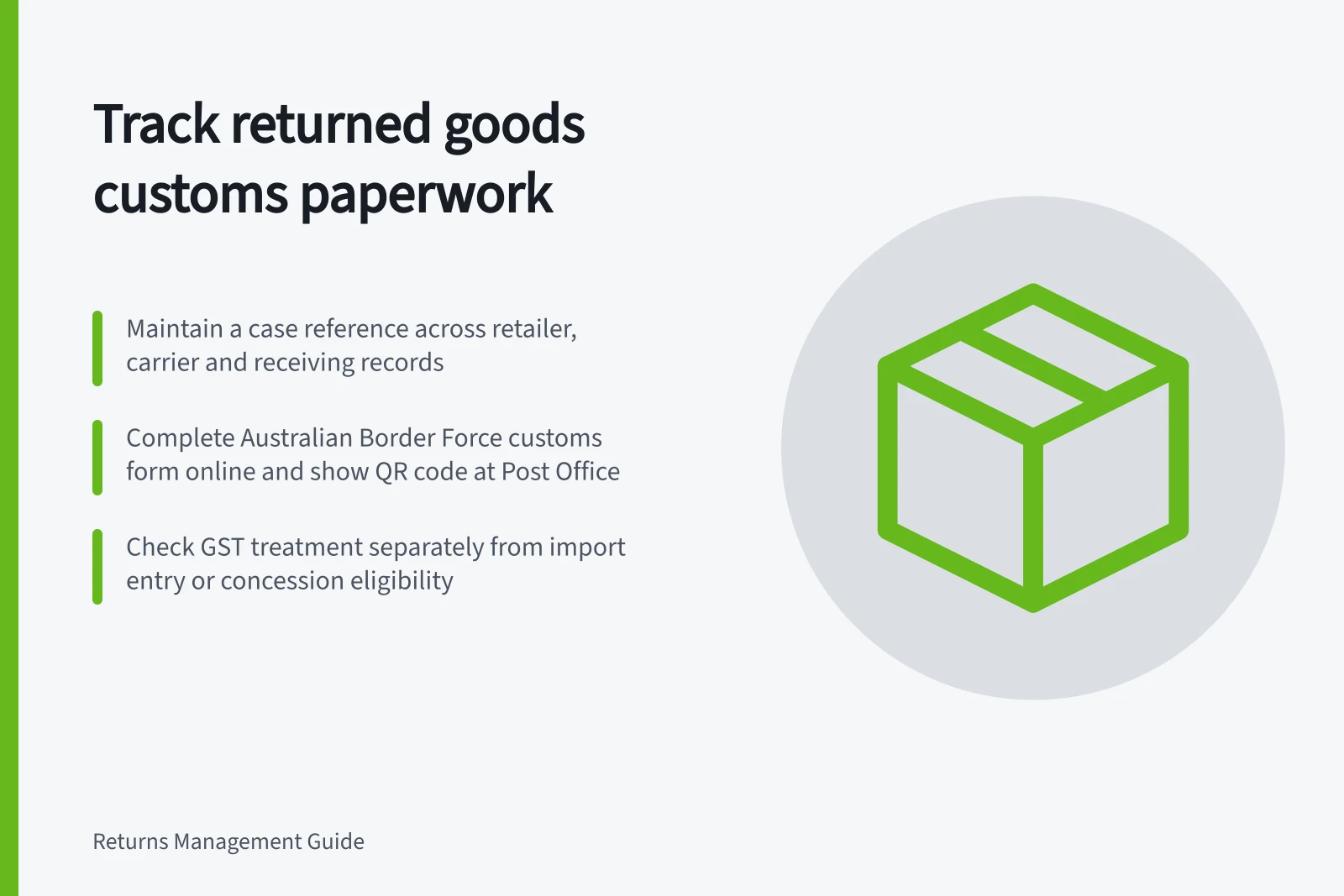
Use one case reference across the retailer, carrier and receiving records. For a parcel containing several items, record each item and its reason for movement; the order number alone may not identify the goods in the parcel.
Keep a document trail
| Record | What it establishes or does not establish | Gap owner |
|---|---|---|
| Original order and dispatch evidence | What was sold and sent; may not identify the returning unit | Retailer |
| Return request and authorisation | Why the retailer expects the item; not customs clearance | Retailer |
| Online customs form and carrier declaration | What was declared for the movement | Sender |
| Confirmation QR code | Online form confirmation; not proof of parcel lodgement | Sender |
| Australian import entry, where required | Entry pathway and reference; not concession eligibility | Importer |
| Carrier event and receiving assessment | Carrier movement; receiving team confirms the unit and condition | Carrier / receiving team |
For Australia Post, complete the customs form online for all available services, then show its confirmation QR code when lodging the parcel at the Post Office. Keep the carrier lodgement event separately: a label or online form confirmation does not prove the parcel was lodged.
Supply accurate quantity, weight, value and purpose information rather than a token value. For exports from Australia, check the Australian Border Force export requirements for the actual consignment before dispatch; the sender or exporter owns missing shipment details.
For goods cleared into home consumption, a Full Import Declaration, Entry for Home Consumption (N10), applies when the combined value is over AUD$1,000. Self-Assessed Clearance (SAC) applies to goods valued at AUD$1,000 or less arriving by air or sea cargo; it cannot be used for international mail or goods under a carnet.
A formal customs entry is lodged through the Integrated Cargo System (ICS). File its entry reference against the case, and keep the carrier movement record separate from the evidence that the physical item was received.
Document Trail Requirements for Returned Goods
- Original order and dispatch evidenceEstablishes what was sold and sent; does not confirm returning unit identity
- Return request and authorisationExplains why the item is being returned; not proof of customs clearance
- Online customs form and carrier declarationConfirms what was declared for movement; sender responsibility
- Confirmation QR codeValidates online form submission; not proof of parcel lodgement
- Australian import entry (if applicable)Provides entry pathway and reference; does not confirm concession eligibility
- Carrier event and receiving assessmentConfirms carrier movement and physical receipt; team confirms unit and condition
Key Thresholds and Rules for Returned Goods in Australia
- Entry type for up to AUD$1,000
- Self-Assessed Clearance (SAC)
- Allowed transport modes for SAC
- Air or sea cargo only
Check a proposed concession separately
Check the current Australian Border Force Schedule 4 guidance before proposing a concession; do not assume every return qualifies. Keep evidence of the original export, the identity and condition of the returning goods, and any work done overseas.
Check GST treatment separately rather than assuming an import entry or concession check settles the tax question.
If key facts are missing or the proposed treatment is unclear, refer the question to the person responsible for customs classification. Record the question and decision rather than copying a code from an earlier case.
Close gaps as they arise
Mark each required record as requested, received, checked or filed, and assign a missing detail to its owner before the parcel reaches the border. The retailer owns sale and return-authorisation evidence; the sender owns item and declaration details; the importer owns the required entry reference.
Match the carrier event to physical receipt, then match the received unit to the case. The carrier owns a missing movement event, while the receiving team owns an unresolved identity or condition check. Preserve any discrepancy between declared and received goods until it is investigated.